The UAE Green Agenda 2030 is a national framework driving the country’s transition toward a sustainable, low-carbon economy as part of the UAE Net Zero 2050 initiative. Businesses across all sectors are increasingly expected to reduce environmental impact, improve ESG transparency, and implement a structured sustainability strategy aligned with national goals.
For UAE companies, sustainability now directly affects regulatory compliance, supplier eligibility, and investor confidence. Conducting a sustainability assessment in the UAE and building a clear sustainability roadmap helps businesses identify ESG risks, improve performance, and demonstrate compliance. Platforms like Synesgy enable organizations to measure ESG performance and develop effective corporate sustainability strategies.
In simple terms:
-
The UAE Green Agenda 2030 requires businesses to integrate sustainability into operations.
-
A sustainability strategy helps companies meet ESG and regulatory expectations.
-
Sustainability assessments enable businesses to track and improve ESG performance.
What is the UAE Green Agenda 2030, and Why is It Important for Businesses?
The UAE Green Agenda 2030 is a national sustainability framework designed to support the country’s transition toward a green, low-carbon economy while maintaining economic growth. It integrates sustainability across energy, infrastructure, industry, transportation, and environmental governance.
Key focus areas include:
-
Expanding renewable energy and improving energy efficiency
-
Promoting sustainable manufacturing and green industries
-
Developing sustainable infrastructure and buildings
-
Strengthening environmental protection and waste management
-
Improving ESG reporting and sustainability data transparency
For businesses, this framework directly influences operational requirements, procurement eligibility, and investment attractiveness. Companies that align their sustainability strategy with national sustainability priorities are better positioned for long-term growth.
How Does the UAE Green Agenda 2030 Affect Companies?
The UAE Green Agenda 2030 affects businesses across regulatory compliance, financing, and supply chain participation.
Increased ESG reporting expectations
Businesses may be required to measure environmental impact, carbon emissions, and governance performance as part of regulatory or partnership requirements.
Supplier and procurement requirements
Government entities and large enterprises increasingly require suppliers to demonstrate sustainability and ESG compliance.
Financing and investor expectations
Banks and investors evaluate sustainability performance when assessing risk and financing eligibility.
Operational efficiency requirements
Companies are encouraged to improve energy efficiency, reduce waste, and adopt sustainable practices to reduce environmental impact.
These changes make sustainability assessment UAE processes essential for companies seeking regulatory readiness and market competitiveness.
What Are the Main UAE Green Agenda 2030 Goals for the Private Sector?
The private sector plays a critical role in achieving UAE sustainability targets. Key business-related goals include:
Reducing emissions and improving energy efficiency
-
Companies are expected to reduce carbon emissions and improve energy performance.
-
Supporting sustainable production and resource efficiency
-
Businesses must adopt environmentally responsible manufacturing, waste reduction, and resource optimization practices.
Strengthening ESG transparency and reporting
-
Organizations are increasingly expected to measure and report ESG performance.
-
Encouraging green investment and innovation
-
Businesses adopting sustainability strategies may benefit from investment opportunities and improved competitiveness.
These goals require companies to implement structured sustainability roadmaps supported by ESG assessment and monitoring tools.
What is a Sustainability Strategy and Why Does Your Business Need One?
A sustainability strategy is a long-term plan that helps businesses reduce environmental impact, improve governance, and operate responsibly while maintaining profitability.
It enables organizations to:
-
Meet ESG compliance requirements
-
Reduce operational risks
-
Improve efficiency and reduce costs
-
Strengthen corporate reputation
-
Align with UAE sustainability regulations
In the UAE, sustainability strategies are increasingly necessary for supplier qualification, regulatory compliance, and investor confidence.
Synesgy helps businesses develop sustainability strategies using measurable ESG data and structured assessments.
How Do You Create an Effective Corporate Sustainability Strategy?
Developing a corporate sustainability strategy requires structured planning and measurable performance tracking.
Conduct a sustainability assessment UAE
An ESG assessment establishes a baseline by evaluating environmental, social, and governance performance.
Synesgy provides digital ESG assessments that generate sustainability scores and detailed performance reports.
Identify sustainability risks and gaps
Companies should evaluate emissions, resource use, governance practices, and operational risks.
Define sustainability goals aligned with UAE priorities
Goals should align with national sustainability targets and business objectives.
Develop a sustainability roadmap
Organizations must define timelines, actions, and responsibilities.
Monitor and report sustainability performance
Continuous monitoring ensures compliance and improvement.
What is an ESG Strategy for Businesses in the UAE?
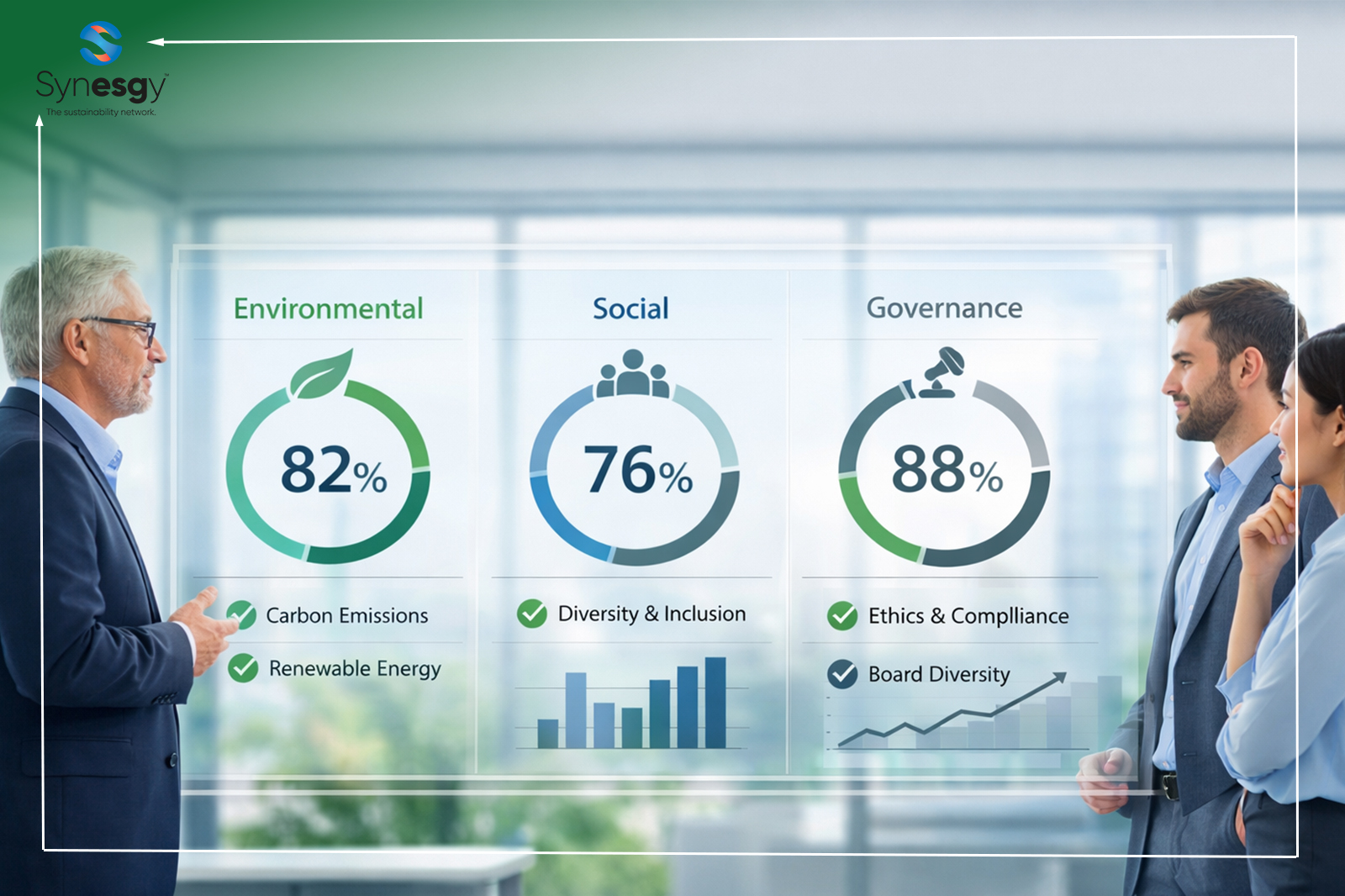
An ESG strategy focuses on improving performance across environmental, social, and governance areas.
-
Environmental factors
-
Reducing emissions, improving energy efficiency, and managing waste.
-
Social factors
-
Ensuring workforce wellbeing, safety, and social responsibility.
-
Governance factors
-
Improving transparency, compliance, and corporate accountability.
An ESG strategy strengthens the overall sustainability strategy and enables businesses to meet UAE sustainability expectations.
Synesgy supports ESG strategy implementation through structured ESG scoring and reporting tools.
What is a Sustainability Assessment in the Uae, and Why Is It Important?
A sustainability assessment UAE evaluates a company’s ESG performance and sustainability maturity.
It helps businesses:
-
Identify sustainability risks
-
Meet ESG compliance requirements
-
Improve credibility with investors and partners
-
Develop sustainability roadmaps
Synesgy enables businesses to conduct ESG assessments using globally recognized methodologies and generate sustainability reports.
What is a Sustainability Roadmap and How Does It Work?
A sustainability roadmap is a structured plan outlining how a company will achieve sustainability goals over time.
It includes:
-
ESG baseline assessment
-
Defined sustainability goals
-
Implementation timeline
-
Performance tracking
A sustainability roadmap ensures sustainability strategy implementation is structured and measurable.
What Are the Steps to Implement a Sustainability Roadmap in the Uae?
Businesses can implement sustainability roadmaps using the following steps:
-
Step 1: Conduct a sustainability assessment in the UAE
Evaluate ESG performance using structured assessment tools like Synesgy.
-
Step 2: Identify sustainability and regulatory requirements
Understand ESG and environmental compliance expectations.
-
Step 3: Define corporate sustainability strategy goals
Set measurable sustainability targets.
-
Step 4: Implement sustainability initiatives
Introduce operational improvements and governance policies.
-
Step 5: Monitor ESG performance
Track sustainability metrics and ESG scores.
-
Step 6: Improve continuously
Refine sustainability strategy using performance data.
How Does Sustainability Strategy Improve Business Competitiveness?
A strong sustainability strategy provides measurable advantages.
-
Improved access to financing: Investors and banks favor ESG-compliant businesses.
-
Increased supplier opportunities: Companies with ESG credentials qualify for more partnerships.
-
Improved operational efficiency: Reducing energy and resource use lowers costs.
-
Stronger brand reputation: Sustainability improves trust and credibility.
How Does Sustainability Help Businesses Comply With Uae Regulations?
Sustainability strategies help companies comply with environmental and ESG expectations.
Businesses must align with:
-
UAE Net Zero 2050 emissions targets
-
Environmental compliance requirements
-
ESG reporting expectations
-
Procurement and supplier sustainability standards
Using ESG assessment platforms such as Synesgy helps businesses demonstrate compliance and reduce regulatory risk.
How Synesgy Helps UAE Businesses Build a Strong Sustainability Strategy
Synesgy is a digital ESG assessment platform designed to help businesses evaluate and improve sustainability performance.
Key capabilities include:
-
ESG assessments aligned with global standards
-
Sustainability scoring recognized by partners and regulators
-
Identification of sustainability risks and gaps
-
Support for sustainability roadmap development
-
Continuous ESG monitoring
Synesgy enables UAE businesses to implement effective sustainability strategies and meet ESG expectations.
Key Takeaways
-
The UAE Green Agenda 2030 and Net Zero 2050 initiatives are accelerating the shift toward sustainable, low-carbon business operations across all industries.
-
Every UAE company, regardless of size or sector, now needs a structured sustainability strategy to meet regulatory expectations, attract investors, and remain competitive in ESG-driven markets.
-
Conducting a sustainability assessment in the UAE is the first step to understanding your organization’s environmental, social, and governance performance and identifying improvement areas.
-
A clearly defined sustainability roadmap helps businesses set measurable ESG goals, implement operational improvements, and track progress over time.
-
ESG strategy for businesses is becoming essential for supplier qualification, financing approval, government procurement, and global supply chain participation.
-
Companies that align with UAE sustainability goals can benefit from improved efficiency, stronger brand reputation, and increased access to investment opportunities.
Conclusion
The UAE Green Agenda 2030 and Net Zero 2050 initiatives are transforming how businesses operate and compete. Sustainability strategy is now essential for regulatory compliance, investor confidence, and supply chain participation.
Businesses that conduct sustainability assessment UAE processes and implement structured sustainability roadmaps are better positioned to meet regulatory requirements and achieve long-term growth.
Synesgy provides the tools companies need to assess ESG performance, implement sustainability strategies, and succeed in the UAE’s evolving green economy.
Start building a future-ready sustainability strategy today. Visit Synesgy to conduct your ESG assessment and align your business with the UAE Green Agenda 2030.
FAQs
Q: Is the UAE Green Agenda 2030 mandatory for businesses?
A: The UAE Green Agenda is a national framework, but its sustainability and ESG requirements increasingly influence regulations and procurement decisions. Businesses that align early are better positioned to meet future compliance requirements and qualify for government and enterprise contracts.
Q: How can companies align with the UAE Green Agenda sustainability targets?
A: Businesses can align by conducting ESG assessments, reducing emissions, and implementing sustainability roadmaps. Integrating ESG reporting and tracking sustainability KPIs helps demonstrate alignment with national and global sustainability expectations.
Q: What are the key components of a business sustainability strategy?
A: Key components include ESG assessment, goal setting, roadmap development, and performance monitoring. Companies must also establish governance policies and reporting systems to ensure continuous ESG improvement.
Q: How can SMEs develop a sustainability strategy in the UAE?
A: SMEs can start with ESG assessments and use platforms like Synesgy to monitor and improve sustainability performance. Setting realistic sustainability goals and tracking progress ensures gradual and cost-effective implementation.
Q: What ESG regulations apply to companies in the UAE?
A: Companies must comply with environmental laws, ESG reporting expectations, and sustainability standards required by regulators and partners. ESG performance is increasingly evaluated during licensing, procurement, and financing processes.
Q: What is the difference between ESG strategy and sustainability strategy?
A: Sustainability strategy is the overall sustainability plan, while ESG strategy focuses specifically on measurable ESG performance. ESG metrics provide the data needed to implement and validate the broader sustainability strategy.
Q: How do companies conduct a sustainability assessment in the UAE?
A: Businesses use ESG assessment platforms such as Synesgy to evaluate sustainability performance. These assessments generate ESG scores and reports that help identify risks and improvement opportunities.
Q: What metrics are used to measure corporate sustainability performance?
A: Metrics include carbon emissions, energy use, waste management, and governance indicators. Companies may also track water usage, supply chain sustainability, and ESG compliance performance.
Q: How long does it take to implement a sustainability strategy?
A: Initial strategies can be developed within weeks, while full implementation may take several months. Continuous monitoring and improvement are required to maintain compliance and achieve long-term sustainability goals.
Q: What risks do companies face without a sustainability strategy?
A: Businesses may face regulatory challenges, lost supplier opportunities, and reduced investor confidence. Lack of ESG visibility can also increase operational risk and limit access to financing and partnerships.