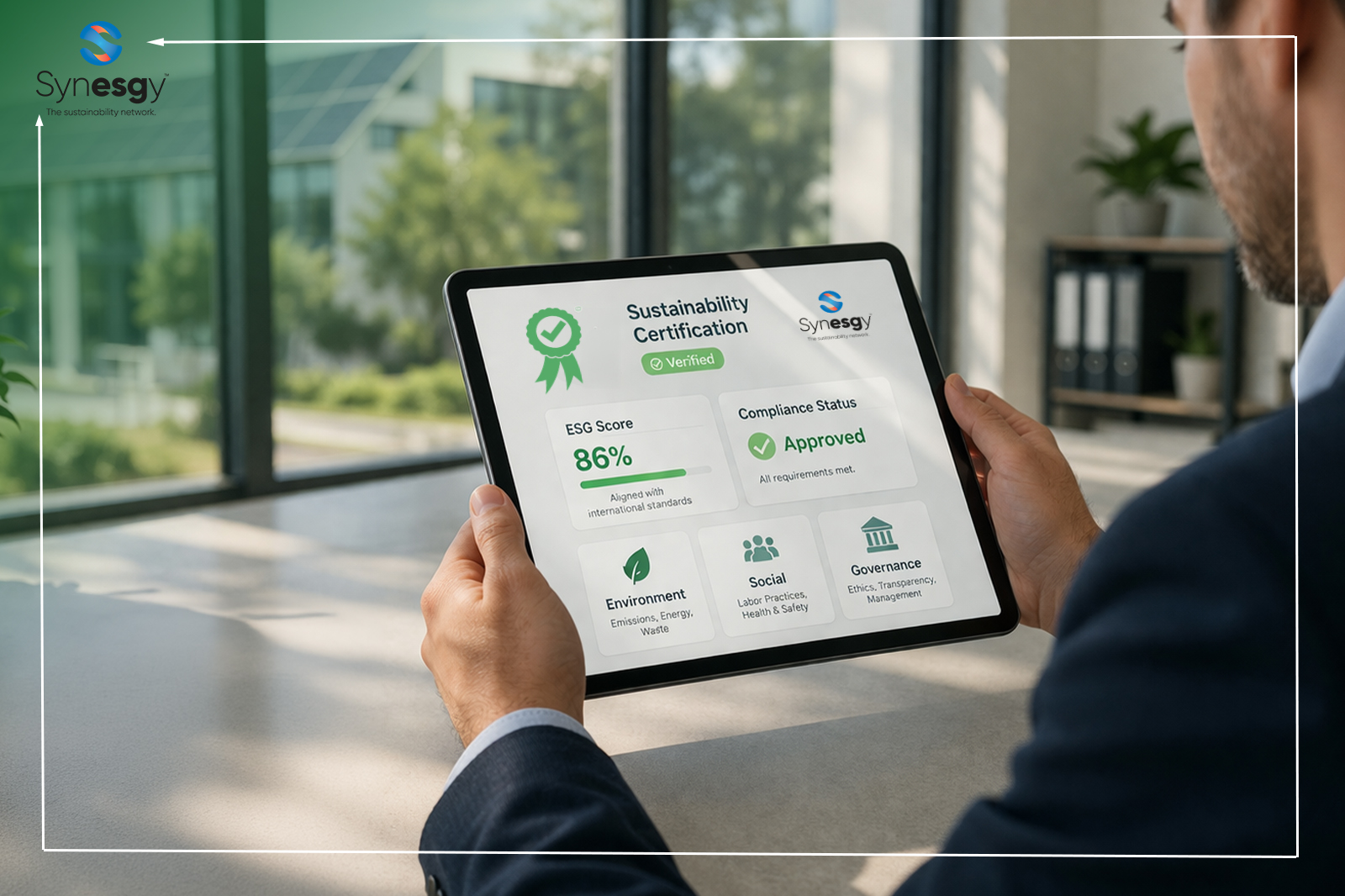
The regulatory environment for listed companies in the UAE is changing rapidly. ESG is no longer a forward-looking initiative or a branding exercise. It is now a compliance requirement that directly impacts regulatory standing, investor confidence, and market credibility.
For companies listed on DFM (Dubai Financial Market) and ADX (Abu Dhabi Securities Exchange), expectations around ESG reporting for listed companies in the UAE have become stricter, more structured, and increasingly enforced. Regulators, investors, and stakeholders are no longer satisfied with self-declared sustainability claims. They expect verifiable proof.
This is exactly where certifications for sustainability become critical. They are no longer a value-add. They are becoming a necessity.
Companies that delay adopting sustainability certifications UAE risk falling behind regulatory expectations, facing increased scrutiny, and losing investor trust. In contrast, organizations that act early position themselves as compliant, credible, and future-ready.
How Do Sustainability Certifications Strengthen Compliance Credibility for Listed Companies?
Compliance today is built on proof, not intent.
While many organizations publish ESG reports, these reports often rely on internal data without external validation. This creates a credibility gap that regulators are actively working to close.
Sustainability certifications UAE eliminate this gap. They provide third-party validation that confirms ESG practices are real, measurable, and aligned with recognized standards.
For a certified sustainable business UAE, this means:
-
ESG disclosures are backed by verified data
-
Compliance claims are supported by independent assessments
-
Regulatory confidence is significantly strengthened
Without certification, companies are increasingly exposed to questions around accuracy, transparency, and compliance integrity.
In a market where credibility directly impacts compliance standing, operating without certification is becoming a measurable risk.
Why Do Stock Exchange–Listed Companies Rely on Third-Party ESG Certifications?
The shift toward third-party validation is not optional. It is being driven by regulators and investors who demand transparency and accountability.
Sustainability due diligence UAE now requires companies to go beyond internal reporting and demonstrate that their ESG practices have been independently verified.
Third-party certifications address this requirement directly by:
-
Removing subjectivity from ESG reporting
-
Standardizing evaluation across companies
-
Providing credible, audit-ready validation
For listed companies, the absence of certification raises concerns about greenwashing and incomplete disclosures.
This is particularly critical in capital markets, where investor decisions are increasingly influenced by ESG performance. Companies without certification are more likely to face:
-
Increased investor skepticism
-
Higher perceived risk
-
Reduced attractiveness in ESG-focused portfolios
Certification is no longer a differentiator. It is becoming a baseline expectation.
How Can Sustainability Certifications Support Audit Readiness and Regulatory Inspections?
Regulatory audits are becoming more frequent and more detailed. Companies are expected to provide structured, verifiable ESG data that aligns with compliance requirements.
Without certifications, preparing for audits can be time-consuming, inconsistent, and risky.
Sustainability certifications UAE change this dynamic by ensuring that ESG data is already validated and documented.
They provide:
-
Pre-verified ESG metrics
-
Structured documentation aligned with compliance standards
-
Clear audit trails for regulatory inspections
This significantly reduces the burden of audit preparation and minimizes the risk of non-compliance findings.
Companies that lack certification often face delays, increased scrutiny, and potential compliance gaps during inspections. In contrast, certified organizations are audit-ready by design.
What Role Do Certifications Play in Aligning ESG Disclosures with Global Standards?
Global alignment is no longer optional for listed companies. Investors and regulators expect ESG disclosures to follow recognized international frameworks.
Green certification for companies ensures that ESG reporting is consistent, standardized, and globally aligned.
Without this alignment, companies risk:
-
Inconsistent reporting formats
-
Limited comparability for investors
-
Reduced credibility in international markets
Certifications help standardize ESG data in line with frameworks such as GRI, SASB, and TCFD, ensuring that disclosures meet both local and global expectations.
For UAE-listed companies competing for global investment, this alignment is critical. Failure to align with global standards can directly impact investor confidence and regulatory perception.
How Do Sustainability Certifications Help Meet Investor-Driven Compliance Expectations?
Investor expectations have shifted dramatically. ESG is now a key factor in investment decisions, risk assessments, and long-term portfolio strategies.
A certified sustainable business UAE is no longer seen as progressive. It is seen as compliant and investable.
Investors are actively looking for:
-
Verified ESG performance
-
Transparent and comparable data
-
Evidence of long-term sustainability commitment
Companies without certification are increasingly viewed as higher risk due to the lack of verified ESG data.
This can lead to:
-
Reduced access to capital
-
Lower valuation potential
-
Limited participation in ESG-focused investment portfolios
Sustainability certifications directly address these concerns by providing the proof investors require. In today’s market, certification is closely tied to financial opportunity.
Can Sustainability Certifications Act as Proof of ESG Performance for Regulators?
Regulators are moving toward evidence-based compliance. Declarations alone are no longer sufficient.
Sustainability certifications UAE provide documented, third-party verified proof of ESG performance, making them a powerful tool in regulatory interactions.
They demonstrate:
-
Compliance with environmental standards
-
Adherence to governance practices
-
Measurable social impact
This reduces the likelihood of regulatory challenges and strengthens the company’s compliance position.
Companies without certification may struggle to substantiate their ESG claims during regulatory reviews, increasing the risk of penalties or corrective actions. Certification transforms ESG from a claim into a defensible compliance asset.
How Do Certifications Bridge the Gap Between ESG Reporting and Actual Compliance?
One of the biggest risks in ESG is the disconnect between what companies report and what they actually implement.
Certifications for sustainability close this gap by validating that reported data reflects real-world practices.
They ensure:
-
ESG initiatives are measurable and verifiable
-
Data is accurate and consistent
-
Compliance is continuous, not periodic
This is especially important in sustainability due diligence UAE, where decisions are based on the reliability of ESG data.
Without certification, companies risk presenting incomplete or inaccurate information, which can lead to compliance failures. Certification ensures that ESG reporting translates into real compliance outcomes.
How Do Sustainability Certifications Integrate with Corporate Risk and Compliance Frameworks?
ESG risks are now part of broader enterprise risk management. Environmental, governance, and social factors can directly impact operations, reputation, and financial performance.
Sustainability certifications integrate ESG into existing compliance frameworks by providing structured, validated data.
This enables companies to:
-
Identify and mitigate ESG risks proactively
-
Monitor compliance continuously
-
Align sustainability with corporate governance
Organizations that fail to integrate ESG into their risk frameworks face increased exposure to regulatory, operational, and reputational risks. Certification ensures that ESG is embedded into the core of business operations rather than treated as a separate initiative.
Why Are Sustainability Certifications Critical for Capital Market Transparency in the UAE?
The UAE is actively strengthening ESG regulations and promoting sustainable finance. Transparency is central to this transformation.
Sustainability certifications UAE play a key role in enabling this transparency by providing consistent, verifiable ESG data for listed companies.
They support:
-
Clear and reliable ESG disclosures
-
Standardized reporting across the market
-
Increased investor trust
As DFM and ADX continue to evolve their ESG requirements, certifications are becoming a critical component of compliance.
Companies that delay adoption risk falling out of alignment with market expectations and regulatory standards. In contrast, early adopters gain a competitive advantage and position themselves as leaders in sustainability and compliance.
Key Takeaways
-
Certifications for sustainability are becoming essential for DFM and ADX-listed companies.
-
ESG reporting alone is no longer sufficient. Verified, third-party validation is now expected.
-
Sustainability certifications UAE strengthen compliance credibility by turning ESG claims into proven, audit-ready evidence.
-
Regulators and investors demand transparency, making certification critical for maintaining trust and avoiding scrutiny.
-
Delaying certification increases compliance and reputational risk, especially as ESG regulations continue to tighten.
-
A certified sustainable business UAE is better positioned to attract investors, meet regulatory expectations, and stay competitive.
-
Certification bridges the gap between reporting and real compliance, ensuring ESG performance is measurable and verifiable.
Conclusion
The direction is clear. ESG compliance is tightening, regulatory expectations are increasing, and investor scrutiny is intensifying.
For DFM and ADX-listed companies, certifications for sustainability are no longer optional. They are becoming essential to maintain compliance standing, protect credibility, and remain competitive in the market.
Companies that act now will be prepared for evolving regulations, stronger audits, and higher investor expectations.
Those who delay risk falling behind, facing compliance challenges, and losing trust in an increasingly transparent market.
The question is no longer whether to adopt sustainability certifications UAE. It is how quickly companies can implement them to secure their position in the future of regulated, sustainable business. If your organization is not yet certified, this is the moment to act.
Start your sustainability certification journey with Synesgy to strengthen your ESG credibility, ensure audit readiness, and stay aligned with UAE regulatory expectations.
FAQs
Q: Are certifications for sustainability mandatory for DFM and ADX-listed companies?
A: Not fully mandatory yet, but they are becoming essential for proving ESG compliance and maintaining credibility. They are quickly evolving into a baseline expectation for listed companies.
Q: Why are sustainability certifications becoming essential for listed companies in the UAE?
A: Because self-reported ESG is no longer enough. Verification is now expected by regulators and investors. Without certification, companies risk reduced transparency and weaker compliance positioning.
Q: How do certifications for sustainability help protect compliance standing?
A: They validate ESG practices with third-party proof, reducing compliance gaps and strengthening credibility. This ensures disclosures are aligned with regulatory and investor expectations.
Q: Can a company rely only on internal ESG reporting without certification?
A: Increasingly risky. Internal reporting lacks the validation regulators and investors expect. This can lead to higher scrutiny and lower trust in ESG disclosures.
Q: How do sustainability certifications support ESG reporting for listed companies UAE?
A: They verify ESG data, improve accuracy, and strengthen audit and regulatory readiness. This makes reporting more consistent, credible, and easier to defend.
Q: What is the difference between ESG reporting and sustainability certification?
A: Reporting shares data. Certification verifies it through an independent assessment. Together, they ensure both transparency and credibility in ESG disclosures.
Q: Why is third-party verification important for a certified sustainable business UAE?
A: It removes bias and builds trust with regulators, investors, and stakeholders. Independent validation strengthens confidence in ESG performance.
Q: How do green certifications for companies improve investor trust?
A: They provide verified ESG proof, reducing risk perception and increasing confidence. This can positively influence investment decisions and funding opportunities.
Q: Do sustainability certifications help during audits and regulatory inspections?
A: Yes. They ensure validated data and documentation, making audits faster and smoother. This reduces compliance pressure and improves audit outcomes.
Q: How does sustainability due diligence UAE connect with certification?
A: Certification strengthens due diligence with verified ESG data instead of assumptions. This improves risk assessment and decision-making accuracy.
Q: What happens if a listed company delays getting sustainability certifications?
A: Delays increase scrutiny, reduce trust, and raise compliance and reputational risks. Late adoption can weaken market positioning and investor confidence.
Q: Are sustainability certifications only useful for environmental compliance?
A: No. They also strengthen governance, social impact, and overall ESG transparency. They support a complete ESG framework across business operations.
Q: Can certifications for sustainability reduce the risk of greenwashing?
A: Yes. They ensure ESG claims are verified and backed by real performance. This helps companies avoid misleading disclosures and reputational damage.
Q: How often should sustainability certifications be renewed or reviewed?
A: Typically, regularly, to keep ESG practices aligned with evolving standards. Continuous updates ensure ongoing compliance and performance improvement.
Q: Are sustainability certifications now a competitive requirement in the UAE market?
A: Yes. Verified ESG performance is becoming essential to stay credible and competitive. Companies without certification risk falling behind market expectations.