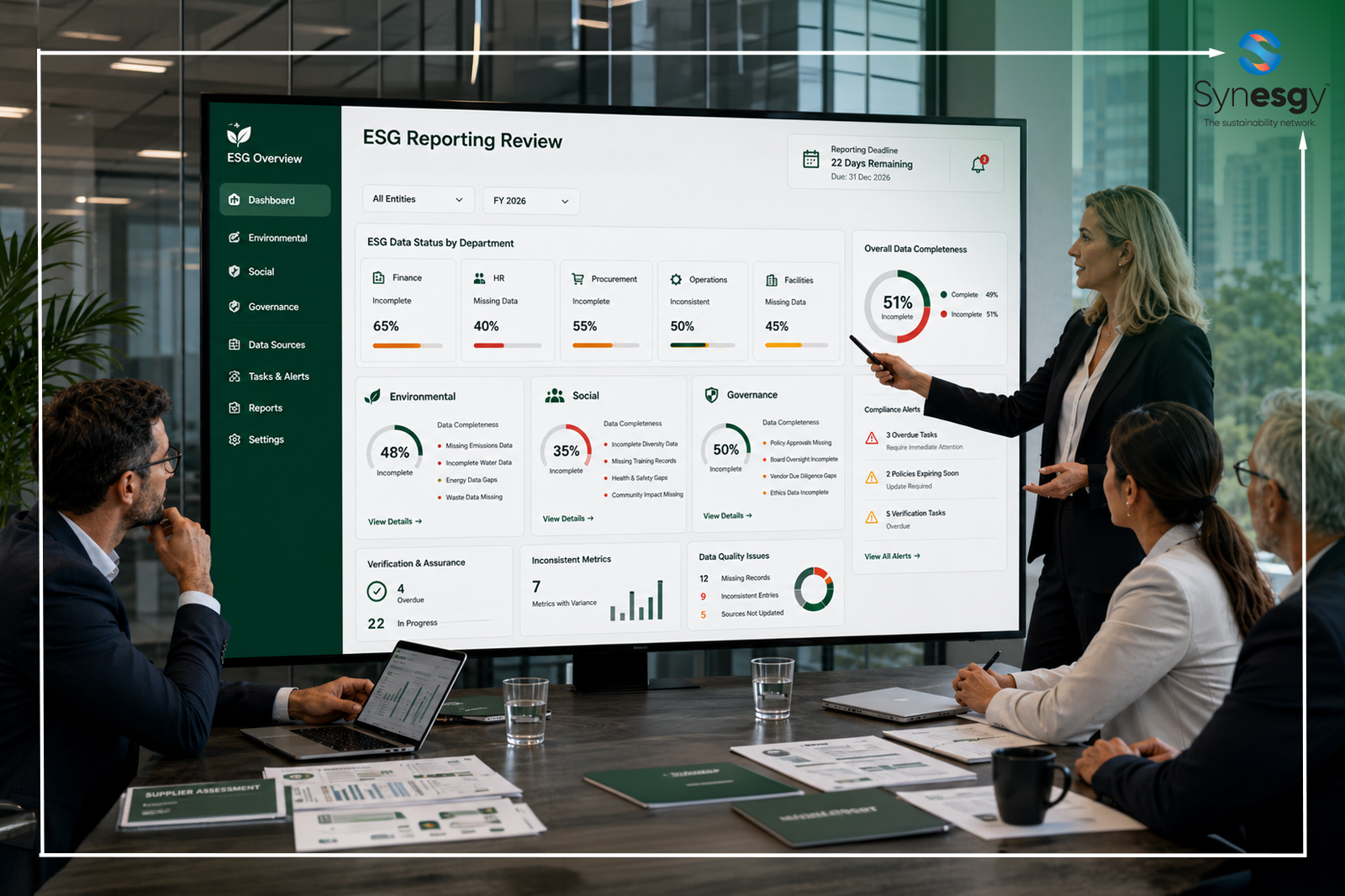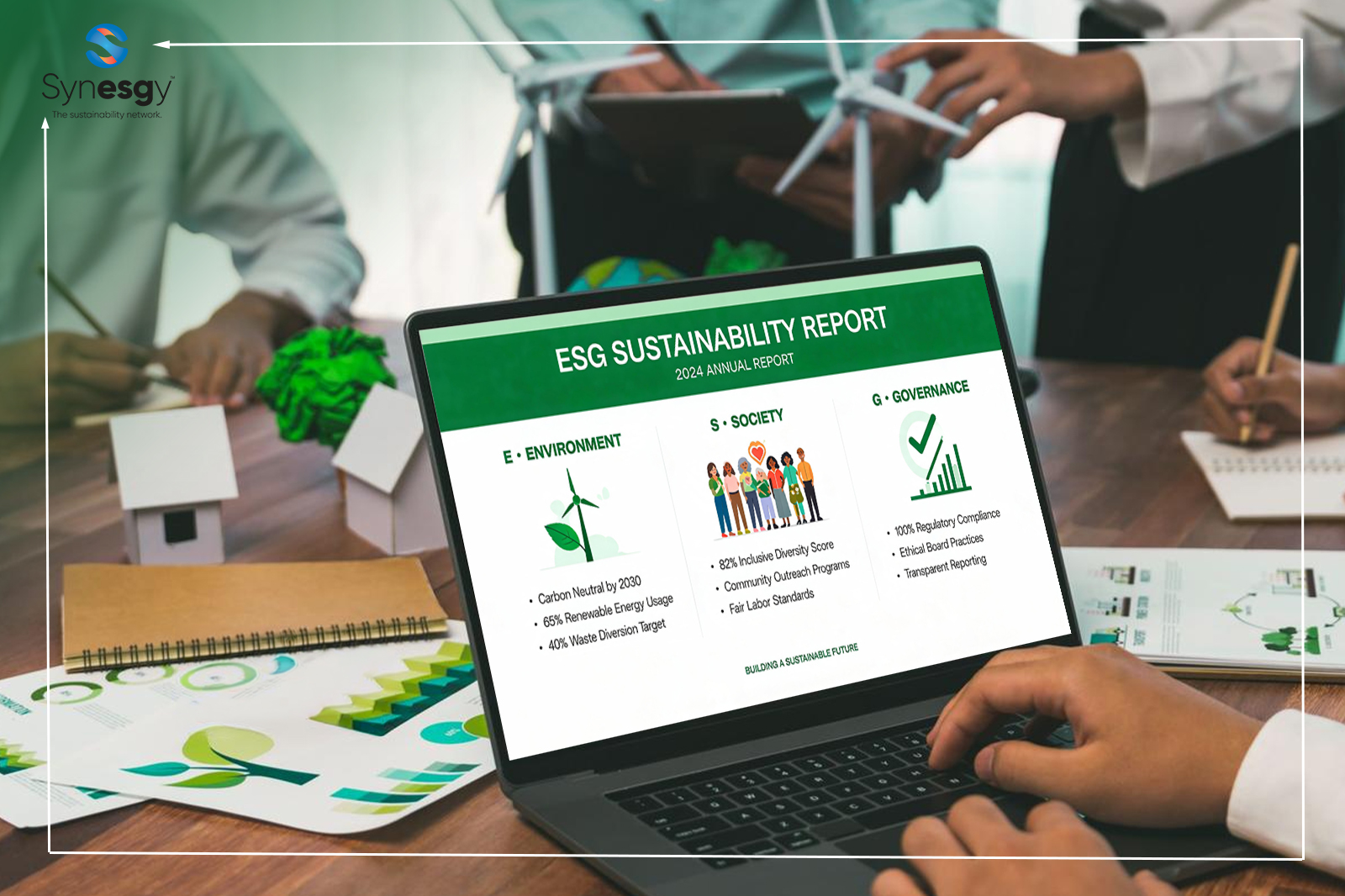
Greenwashing in an ESG report occurs when a company’s sustainability disclosures overstate, misrepresent, or selectively present environmental and social performance in ways that mislead stakeholders. It is not always intentional. Many companies publish ESG sustainability reports that contain greenwashing indicators without realising it, and regulators in the UAE and globally are becoming far more precise about what they flag.
If your ESG sustainability report contains vague targets, unverified data, or incomplete emissions disclosures, it is already at risk. This article identifies the five most common red flags that compliance teams, investors, and regulators look for, and explains what your organisation needs to address before publishing.
Why UAE Regulators Are Tightening Scrutiny on ESG Sustainability Reports
The difference between credible sustainability reporting and greenwashing comes down to transparency and evidence. A reliable ESG report includes measurable targets, independently verifiable data, clear methodologies, and disclosure of all material ESG issues, including weaker performance areas. Greenwashed reports typically rely on vague commitments, selective metrics, and unsupported sustainability claims.
ESG disclosure expectations in the UAE have increased significantly following SCA sustainability disclosure guidelines, ADX and DFM reporting requirements, the UAE Net Zero 2050 initiative, and the country’s broader post-COP28 sustainability agenda. As a result, both listed and private sector companies face growing pressure to improve ESG transparency and reporting accuracy.
Today, greenwashing risk extends beyond reputational damage. UAE businesses may face:
-
regulatory scrutiny and disclosure investigations
-
investor and stakeholder distrust
-
procurement disqualification
-
exclusion from ESG-linked financing opportunities
International frameworks such as GRI, TCFD, ISSB, and ESRS help reduce greenwashing risk, but framework adoption alone is not enough. ESG credibility ultimately depends on how sustainability data is collected, validated, documented, and disclosed…
Red Flag 1: Vague ESG Targets and Unmeasurable Sustainability Claims
Vague ESG targets are one of the most common indicators of greenwashing in sustainability reports. Statements such as “we aim to become more sustainable” or “reduce environmental impact” lack measurable outcomes, timelines, baselines, and accountability, making them impossible to verify independently. Regulators and ESG rating agencies increasingly view these unsupported commitments as material disclosure gaps rather than minor reporting issues.
Credible ESG targets should include:
-
a defined baseline year
-
clear scope and metrics
-
measurable reduction or performance goals
-
a target deadline and interim milestones
-
accountability and governance mechanisms
For example, a target such as “reduce Scope 1 and Scope 2 emissions by 30% against a 2022 baseline by 2030” is verifiable. Generic statements like “achieve carbon neutrality by 2040” without methodology or supporting data are not.
Another major red flag appears when companies avoid setting targets for material ESG risks identified during the materiality assessment. Regulators increasingly assess whether ESG targets address the most significant operational and sector-specific risks, not only areas where positive progress is easier to demonstrate.
What to check: Review every target in your ESG sustainability report. If a target cannot be tracked with a specific metric, it should not be published as a commitment.
Red Flag 2: ESG Data With No Independent Verification or Third-Party Assurance
Unverified ESG data is one of the biggest credibility risks in sustainability reporting. Regulators, investors, procurement teams, and rating agencies treat ESG disclosures without third-party assurance as lower-trust, self-reported information.
ESG assurance involves an independent review of the company’s ESG data, reporting methodology, and controls to confirm whether disclosures are materially accurate. Limited assurance checks overall plausibility, while reasonable assurance applies deeper audit-level testing.
A sustainability report may face greenwashing concerns when:
-
ESG claims are not independently verified
-
reporting methodologies are unclear or inconsistent
-
Data cannot be traced back to source systems
-
performance figures lack assurance statements
For investors and enterprise procurement teams, the first credibility check is often whether the report includes independent ESG verification.
In the UAE, supplier sustainability assessments increasingly require verified ESG data for procurement qualification and onboarding. Companies with unverified sustainability claims may face exclusion from tenders, regulated supply chains, and ESG-linked commercial opportunities.
Strong ESG data quality depends on:
-
accurate and complete disclosures
-
consistent reporting methodology
-
traceable source data
-
third-party assurance readiness
What to check: Confirm whether your ESG sustainability report includes a third-party assurance statement. If it does not, identify whether your data collection systems are audit-ready before your next reporting cycle.
Red Flag 3: Cherry-Picking ESG Metrics While Hiding Poor Performance
Cherry-picking ESG metrics is a common form of greenwashing where companies highlight only positive sustainability results while omitting weaker or negative performance areas. The report may appear detailed, but the disclosure is strategically incomplete.
Regulators and ESG analysts identify this by comparing disclosed metrics against the company’s materiality assessment. Greenwashing concerns arise when material issues are identified, but related performance data is missing.
Common red flags include:
-
reporting employee training hours but omitting workplace injury rates
-
identifying water consumption as material, but providing no water data
-
highlighting emissions reductions while excluding Scope 3 emissions
-
disclosing sustainability targets without reporting missed targets or declining performance
Frameworks such as GRI and ISSB require disclosure of all material ESG topics, including underperformance. Omitting negative results weakens ESG report credibility and signals potential reporting risk to investors, regulators, and procurement teams.
How do regulators detect greenwashing in sustainability reports?
One primary method is comparing the ESG issues a company has publicly acknowledged as material against the data actually disclosed. Gaps between materiality commitments and reported content are a direct investigation trigger.
What to check: Map every material ESG topic identified in your materiality assessment against the data actually published. Any material topic with no corresponding data is a disclosure gap that needs to be addressed or formally explained.
Red Flag 4: Missing or Incomplete Scope 1, 2, and 3 Emissions Disclosure
Incomplete Scope 1, 2, and 3 emissions disclosure is one of the most heavily scrutinised areas in ESG sustainability reporting and a major source of greenwashing risk. Scope 1 covers direct operational emissions, Scope 2 covers purchased energy emissions, and Scope 3 includes indirect value chain emissions such as supplier activity, product use, and disposal.
Many companies disclose only Scope 1 and 2 emissions because the data is easier to collect, while omitting Scope 3, even though it often represents 70–90% of total emissions. Claiming climate leadership without comprehensive Scope 3 reporting can significantly distort actual carbon footprint visibility.
Frameworks such as TCFD, ISSB IFRS S2, and the EU CSRD increasingly expect complete emissions disclosure, particularly for companies with international operations, investors, or supply chain exposure.
Common reporting issues flagged by auditors include:
-
Incomplete Scope 3 disclosure
-
exclusion of high-emission categories
-
outdated emission factors
-
unclear methodology disclosures
-
use of market-based Scope 2 figures without transparency
Accurate carbon footprint reporting depends on both complete emissions coverage and consistent, verifiable calculation methodologies.
What to check: Confirm that your emissions disclosure clearly states the boundaries of each scope, the emission factors applied, the calculation methodology, and any categories excluded, with the reason for exclusion.
Red Flag 5: Misleading Sustainability Claims in Annual Report Language
Misleading sustainability claims are one of the biggest greenwashing risks in ESG reports because they appear in documents reviewed by regulators and investors. Claims may be technically accurate but still misleading when they lack context, supporting evidence, or clear methodology.
Regulators increasingly expect environmental claims to be substantiated with verifiable data. While the UAE does not yet have legislation equivalent to the EU Green Claims Directive, UAE companies with global investors, suppliers, or customers may still face indirect compliance pressure.
Common greenwashing red flags include:
-
claiming “carbon neutrality” without verified offset methodology
-
reporting “zero waste to landfill” for only part of operations
-
using percentage improvement figures without disclosing the baseline year or reporting scope
-
making broad sustainability statements without measurable evidence
Regulators and legal teams increasingly use language analysis to identify unsupported absolute claims such as “fully sustainable” or “clean operations.” Claims without qualifying context or supporting data are often treated as warning signs.
Strong ESG data quality requires every narrative statement, including CEO messages and executive summaries, to align with disclosed metrics and verified reporting data. Disconnects between narrative claims and actual ESG figures are a major source of regulatory scrutiny.
What to check: Review all sustainability claims in your report’s narrative sections against the data disclosed. Any claim that cannot be traced to a specific metric, data table, or independently verified figure should be revised or removed.
What UAE Regulators and Investors Flag As Greenwashing in ESG Sustainability Reports
What regulators look for in ESG reports in the UAE closely aligns with international frameworks while incorporating local disclosure expectations. The SCA, ADX, and DFM expect ESG disclosures to be material, accurate, measurable, and aligned with recognised frameworks such as GRI and TCFD. UAE-listed companies are expected to publish annual sustainability reports covering governance, environmental, and social performance with clear year-on-year progress tracking.
Reports that rely on aspirational language without measurable data, disclose only positive outcomes, or omit material ESG risks are increasingly exposed to regulatory scrutiny.
The SCA can investigate misleading ESG disclosures under UAE securities law. Risks for listed companies include regulatory investigation, mandatory restatement, reputational damage, investor confidence loss, and potential delisting exposure. ADX and DFM are placing increasing focus on the quality and credibility of sustainability disclosures, not just whether reports are published.
For non-listed companies, greenwashing risk is largely commercial. Many UAE government-linked entities, multinational enterprises, and procurement ecosystems now require verified ESG assessments as part of supplier qualification and vendor risk evaluation.
Dubai and Abu Dhabi’s sustainability agendas continue to strengthen expectations around transparent and verifiable ESG disclosure across both public and private sector environments.
How a Third-Party Esg Sustainability Report Protects Your Uae Business From Greenwashing Allegations
Avoiding greenwashing in an ESG sustainability report depends on one principle: every ESG claim must be backed by traceable, verifiable data. This requires structured ESG data governance, documented methodologies, and consistent reporting processes throughout the year, not just during report preparation.
Third-party ESG verification helps UAE businesses reduce greenwashing exposure in two ways:
-
validates ESG disclosures through independent review
-
demonstrates external scrutiny to regulators, investors, and procurement teams
Improving ESG report credibility starts with aligning disclosures with evidence. Businesses should:
-
conduct honest materiality assessments
-
report on all material ESG issues, including weaker performance areas
-
standardize ESG data collection across operations
-
maintain supporting documentation and audit trails
-
engage independent ESG reviewers before publication
For companies seeking ESG report verification support in the UAE, the priority should be a platform that structures ESG data collection, standardizes metrics, and supports recognized reporting frameworks.
Conclusion
Greenwashing in ESG sustainability reports is no longer a reputational risk alone. In the UAE, it carries regulatory, commercial, and financial consequences that affect procurement qualification, investor access, and compliance standing. The five red flags covered in this article, from vague targets to unverified data, are the exact areas regulators and investors examine first. Addressing them before publication is not optional. It is the baseline standard for credible ESG disclosure in 2026.
Synesgy UAE helps businesses identify disclosure gaps, verify ESG data, and publish sustainability reports that meet UAE regulatory and investor standards.
For more insights:
E-mail: info.me@crif.com
FAQs
Q: What is greenwashing in an ESG report?
A: Greenwashing occurs when ESG disclosures exaggerate, misrepresent, or selectively present sustainability performance beyond what the data supports. Common signs include vague targets, cherry-picked metrics, and unverified claims.
Q: What makes an ESG sustainability report non-compliant in the UAE?
A: An ESG report may be considered non-compliant if it omits material ESG topics, uses unverified claims, lacks measurable data, or does not follow recognised frameworks such as GRI or TCFD. For UAE-listed companies, failing to publish adequate ESG disclosures under ADX, DFM, or SCA expectations can also create compliance risk.
Q: What are the penalties for greenwashing in ESG reporting?
A: Greenwashing can lead to regulatory scrutiny, mandatory disclosure corrections, reputational damage, investor distrust, tender disqualification, and restricted access to ESG-linked financing or procurement ecosystems.
Q: Which ESG framework protects against greenwashing allegations?
A: Frameworks such as GRI, TCFD, and ISSB IFRS S1/S2 help improve disclosure quality, but they only reduce greenwashing risk when reporting is complete, transparent, and supported by verifiable data and independent review.
Q: How do I know if my ESG report will be flagged as greenwashing?
A: ESG reports carry higher greenwashing risk when material topics are missing, targets are vague, data is unverifiable, or sustainability claims are not backed by measurable evidence. Third-party ESG assessment platforms like Synesgy UAE help identify these gaps before publication.
Q: Can a company be fined for greenwashing in the UAE?
A: Listed companies can face regulatory investigation, disclosure restatements, formal censure, and legal action for misleading ESG disclosures. Unlisted companies face commercial risks, including procurement exclusion, financing restrictions, and reputational damage.
Q: How can companies make an ESG sustainability report credible?
A: Credible ESG reports require:
-
honest materiality assessments
-
measurable, time-bound targets
-
traceable and consistent ESG data
-
independent third-party verification
Every sustainability claim should be supported by verifiable evidence.
Q: Is my sustainability report at risk of greenwashing?
A: A report carries greenwashing risk if:
-
Material ESG topics are missing
-
Targets are vague or unmeasurable
-
Data is entirely self-reported
-
Sustainability claims lack supporting evidence
Unverified data and incomplete Scope 3 disclosure are common UAE reporting gaps.
Q: What do investors look for in an ESG report?
A: Investors typically assess:
-
completeness of ESG disclosures
-
measurable targets and baselines
-
independent data verification
-
consistency in reporting methodology
These factors increasingly influence ESG-linked financing and procurement decisions in the UAE.
For more insights:
E-mail: info.me@crif.com