Sustainability is now a boardroom priority, driven by rising regulations, investor scrutiny, and global buyer expectations for verified ESG supply chain data.
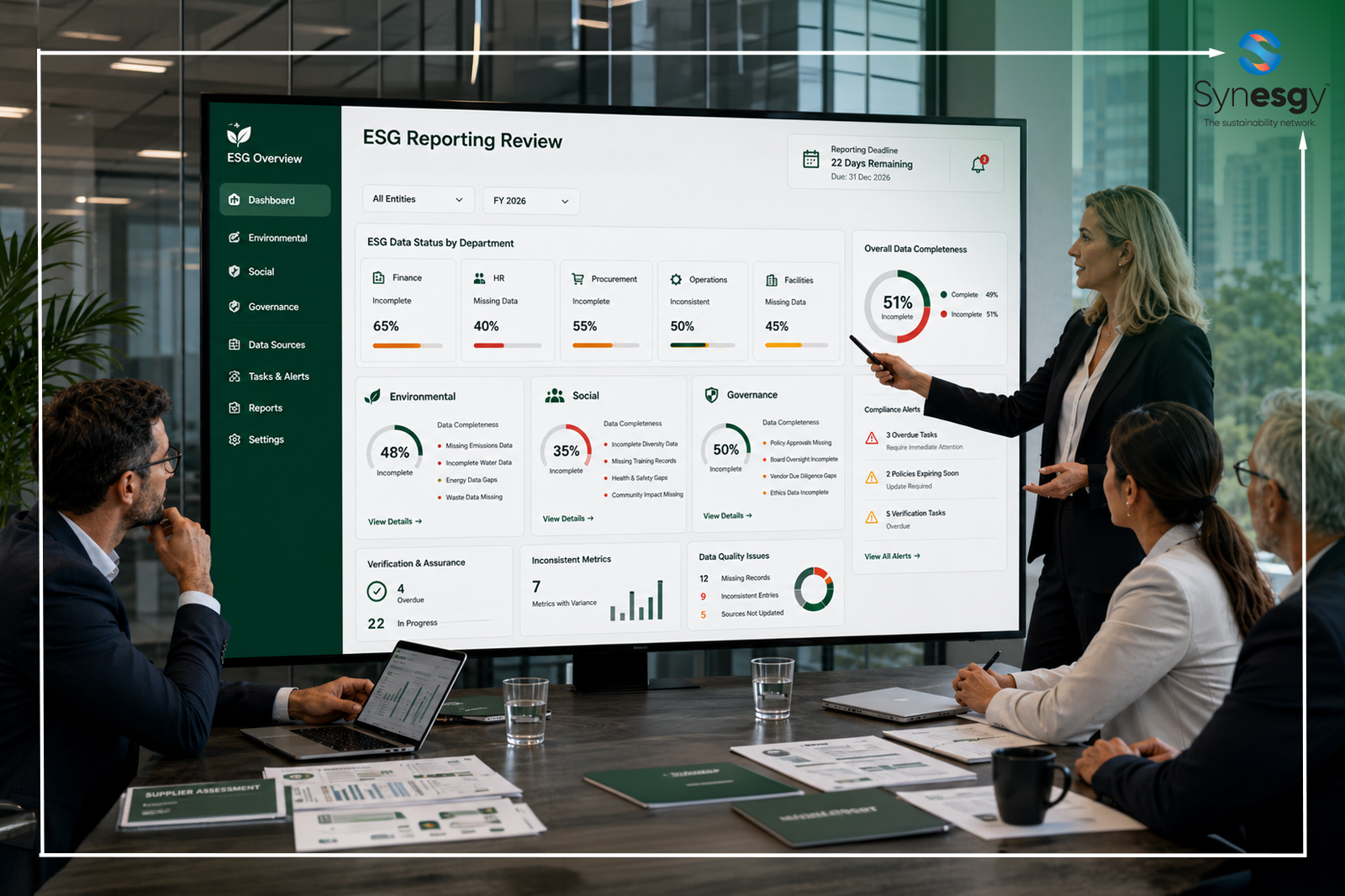
Yet many organisations still depend on outdated audits, unverified questionnaires, and disconnected ESG data that fail to support procurement decisions.
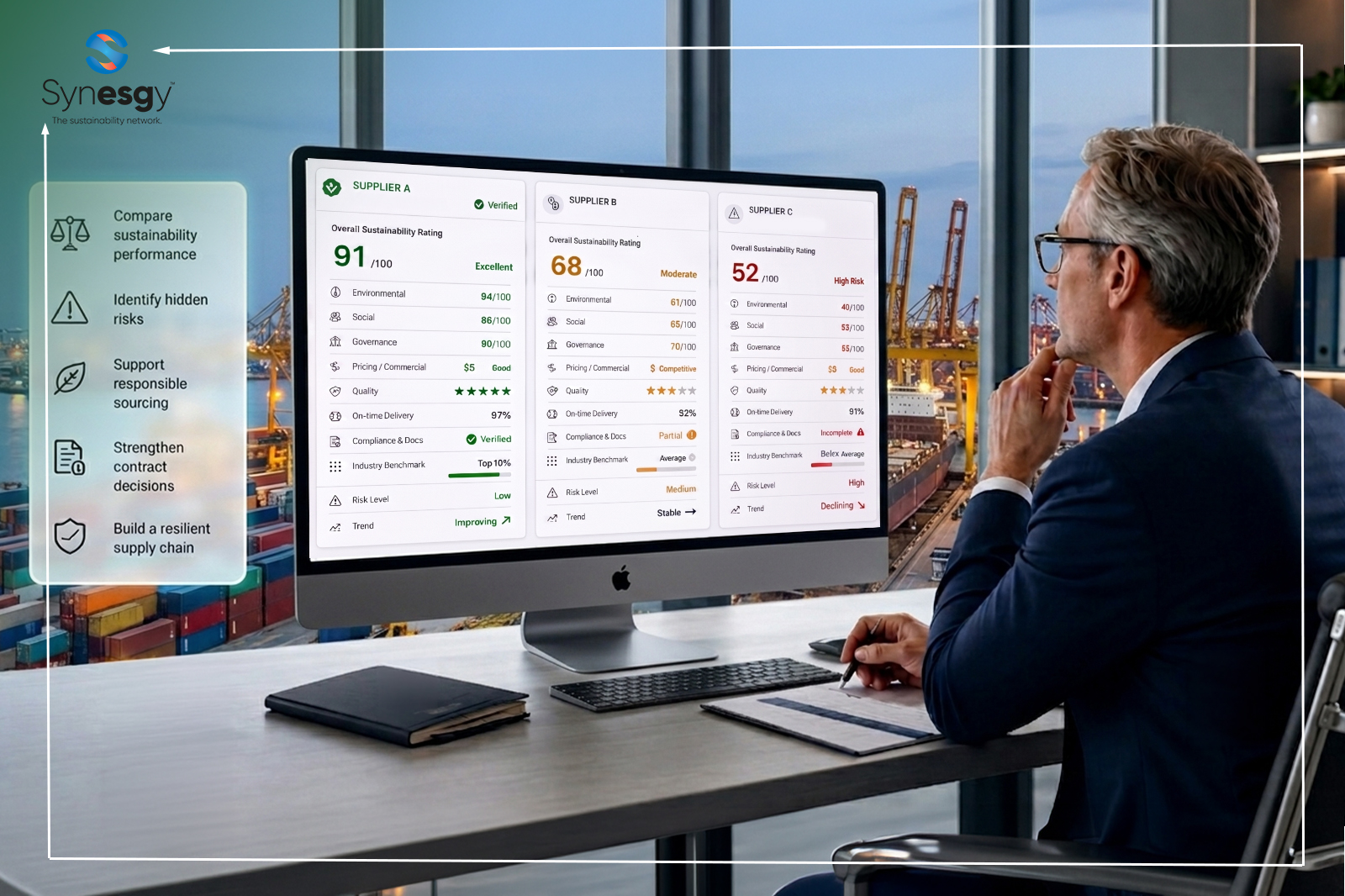
A supplier ESG risk scoring model addresses this by turning fragmented sustainability data into a clear, decision-ready risk score that supports stronger procurement and supply chain sustainability outcomes.
This guide covers:
-
Building a supplier ESG assessment framework
-
Defining ESG criteria, weightings, and scoring models
-
Collecting and validating supplier ESG data
-
Classifying suppliers into ESG risk tiers
-
Integrating ESG scores into procurement and contract decisions
-
Monitoring supplier ESG performance and regulatory compliance continuously
What Is a Supplier ESG Risk Scoring Model and Why Does Supply Chain Sustainability Depend on It?
A supplier ESG risk scoring model evaluates each supplier across Environmental, Social, and Governance dimensions and assigns a quantified risk score, enabling procurement teams to compare, rank, and act on supplier sustainability performance at scale.
Unlike a one-off audit, it is systematic and continuous. It converts supplier questionnaires, public disclosures, third-party assessments, and incident data into a consistent numeric output that tells you which suppliers advance your sustainability commitments and which ones undermine them.
The model produces three outputs:
-
An overall ESG risk score (0–100, higher scores indicating lower risk)
-
Pillar-level sub-scores for Environment, Social, and Governance independently
-
A risk tier classification( High, Medium, or Low) that triggers defined procurement responses
Why Supply Chain Sustainability Cannot Wait
Operating without a structured ESG supply chain assessment creates measurable commercial, regulatory, and reputational exposure.
UAE and GCC enterprises face obligations from multiple directions simultaneously:
-
The UAE Securities and Commodities Authority (SCA) requires mandatory sustainability reporting for listed entities, with supply chain data increasingly within scope.
-
The UAE Net Zero by 2050 strategy creates strong expectations for emissions accountability across Scopes 1–3, including supplier emissions data.
-
Major national purchasers, including ADNOC, already require contractors to submit ESG performance evidence, setting a market precedent that is spreading across GCC procurement ecosystems.
Without a scoring model, procurement teams cannot prioritise remediation, demonstrate consistent due diligence to regulators, or provide evidence when customers require proof of sustainable supply chain practices.
Step 1: Define Your Esg Scoring Dimensions and Sub-Criteria
What metrics should be included in a supplier ESG scorecard?
The foundation of any supplier ESG risk scoring model, and of any credible green supply chain management programme, is a precise definition of what you are measuring. This means translating the broad ESG framework into specific, measurable criteria that are relevant to your industry, geography, and procurement categories.
ESG Supplier Scorecard: Dimensions, Criteria, and Example Metrics
-
Environmental (E)
Carbon & emissions: Scope 1, 2, and 3 emissions intensity; GHG reduction targets; net zero alignment. Primary data source: CDP disclosure and self-reported data.
Energy management: Renewable energy share; energy intensity per unit output. Primary data source: self-reported data and utility records.
Water & waste: Water consumption intensity; waste diversion rate; hazardous waste handling procedures. Primary data source: self-reported data and site audits.
Environmental compliance: Regulatory violations; pending environmental litigation; spill incidents. Primary data source: public records and legal databases.
Biodiversity & land use: Land-use risk in sourcing regions; deforestation exposure in upstream supply. Primary data source: third-party screening tools.
Social (S)
Labour standards: Living wage compliance; working hours policy; child and forced labour prohibition. Primary data source: audit reports and certifications.
Health & safety: Lost-time injury rate; fatality incidents; HSE management system certification status. Primary data source: self-reported data and audit records.
Human rights: Human rights due diligence policy; grievance mechanism; remediation processes. Primary data source: self-reported data and third-party assessments.
Diversity & inclusion: Gender pay gap; leadership diversity metrics; equal opportunities policy. Primary data source: self-reported data and public reports.
Community impact: Local employment share; community investment programmes. Primary data source: self-reported data.
Governance (G)
Business ethics: Anti-corruption and anti-bribery policy; whistleblower mechanisms; employee training programmes. Primary data source: self-reported data and certifications.
Transparency & reporting: ESG disclosure quality; audit trail completeness; reporting framework alignment (GRI, SASB, TCFD). Primary data source: third-party ratings and public filings.
Board oversight: ESG oversight at the board level; sustainability governance structure and accountability. Primary data source: public filings and governance reports.
Regulatory compliance: Sanctions screening; legal violations; regulatory filing status. Primary data source: legal databases and public records.
Data security: Cybersecurity policy; data breach history; third-party security certifications. Primary data source: self-reported data and incident databases.
Criteria selection should be calibrated to your sector. For a UAE oil and gas procurement team building a green supply chain management programme, environmental performance and health and safety dominate the risk picture. For a retail procurement team focused on supply chain sustainability in soft goods, labour standards and human rights in upstream sourcing carry the greatest weight.
How to Weight E, S, and G for Your Industry and Risk Appetite
One of the most consequential and most underserved questions in supplier ESG risk scoring is how to weight the three pillars against each other. Equal weighting, 33% E, 33% S, 33% G, is a common default but rarely the most accurate reflection of real-world supply chain sustainability risk.
Oil & gas/energy
-
Environment: 40%
-
Social: 35%
-
Governance: 25%
Rationale: emissions, spill risk, and worker safety are the dominant material risks in this sector.
Retail / consumer goods
-
Environment: 25%
-
Social: 50%
-
Governance: 25%
Rationale: Labour rights and supply chain human rights carry the greatest reputational and regulatory risk.
Financial services
-
Environment: 20%
-
Social: 30%
-
Governance: 50%
Rationale: governance, anti-corruption, and regulatory compliance are existential risk dimensions.
Construction / real estate
-
Environment: 35%
-
Social: 40%
-
Governance: 25%
Rationale: environmental footprint and worker safety, particularly migrant worker welfare in the GCC, are the primary risk vectors.
Technology / IT services
-
Environment: 20%
-
Social: 35%
-
Governance: 45%
Rationale: data governance, cybersecurity, and business ethics dominate the material risk profile.
Step 2: Identify and Collect Your ESG Data Sources
What ESG data points matter most for supplier risk?
A scoring model is only as reliable as the data that feeds it. The most robust approaches combine four categories:
-
Supplier self-reported data
Suppliers complete a structured ESG questionnaire covering environmental performance, social policies, and governance structures. It offers broad coverage but carries inherent bias and must always be validated.
-
Public records and regulatory data
Government databases, environmental agency records, court filings, sanctions lists, and labour authority data provide verified compliance history. In the UAE, relevant sources include MOEI environmental records, MoHRE labour compliance data, and ADNOC supplier qualification registries.
-
Third-party ESG intelligence
Specialist platforms aggregate and score supplier ESG performance using external data feeds, media monitoring, and incident databases. More objective than self-reported data but may have gaps for smaller GCC suppliers with limited public disclosure.
-
On-site audit and inspection data
Physical assessments provide the highest-confidence data for health and safety, working conditions, and environmental compliance. Indispensable for high-risk or high-spend suppliers, though not scalable across an entire base.
What ESG data sources are available for procurement teams in the UAE?
UAE-based procurement teams building sustainable supply chain solutions have access to a growing but still developing regional ESG data ecosystem:
UAE-specific ESG data sources include:
-
Synesgy: localised ESG assessments, supplier scoring, and GCC-specific risk intelligence purpose-built for the regional market.
-
CDP Middle East disclosures: growing participation from UAE-listed companies and their suppliers.
-
Tadawul / DFM / ADX ESG reports: available for all publicly listed UAE entities.
-
ADNOC Supplier Qualification System (SQS): HSE and compliance data for energy sector suppliers.
-
UAE MoHRE Wage Protection System: labour compliance indicators covering wage records and workforce registration.
-
UAE SCA ESG filings: mandatory disclosure data from listed companies, increasingly inclusive of Scope 3 reporting.
-
ADGM sustainability disclosures: governance and ESG reporting from ADGM-registered entities.
-
Global Sanctions Lists (UN, OFAC, EU): mandatory for governance screening in any ESG supply chain assessment.
-
Government and regulatory databases: MOEI environmental records and DED business registration and compliance data.
For many GCC-based SMEs and tier-2 suppliers, structured data is sparse or absent. In these cases, a validated self-assessment questionnaire remains the primary data collection mechanism.
How to validate supplier ESG self-reported data
CDP research indicates that up to 40% of corporate environmental disclosures contain material inaccuracies when independently verified. Accepting unvalidated data is itself a compliance and reputational risk.
A four-step validation process:
-
Document verification: Request primary evidence for all material claims: energy bills, safety records, policy documents, and certifications such as ISO 14001, ISO 45001, and SA8000.
-
Public record checks: Cross-reference supplier claims against regulatory databases, court records, and media monitoring. Discrepancies trigger automatic score adjustments and escalation flags.
-
Third-party verification: Where available, compare self-reported responses against CDP disclosures or Synesgy assessments. Significant divergences flag data quality issues or misrepresentation.
-
Targeted follow-up: For high-risk or high-spend suppliers, conduct clarification calls or site visits to verify specific data points. Maintain a full audit trail for regulatory due diligence.
Validated data carries full scoring weight. Unverified claims are discounted. Contradicted claims trigger score penalties and escalation.
Step 3: Build Your Scoring Model: Quantitative and Qualitative Methods
How do you score suppliers on ESG performance?
With criteria defined and data collected, the next step is translating inputs into scores. Three primary approaches are commonly used across supply chain sustainability programmes, each with distinct strengths for different organisational contexts.
Scoring Method Comparison
-
Weighted average
Each criterion scored 0–100, multiplied by its weight, and summed to a total. Transparent and auditable. Limitation: compensatory, a strong score on one criterion can offset a weak score on another.
-
Tiered threshold
Suppliers must meet minimum scores on critical criteria regardless of their overall average. Failing a threshold triggers automatic high-risk classification. Limitation: requires a precise threshold definition and is more complex to administer.
-
Binary compliance gate
Certain criteria are strictly pass/fail. Failures disqualify or escalate regardless of all other performance. Best for sanctions screening, forced labour checks, and regulatory compliance. Limitation: cannot capture degrees of performance.
-
Hybrid model
Weighted average for performance dimensions combined with binary gates for non-negotiable criteria. Recommended for most UAE enterprises. Limitation: requires clear, documented delineation between gated and scored criteria upfront.
Use a 0–100 scale throughout, normalised to industry benchmarks so that a score of 50 represents sector-average performance, not simply the midpoint of your data range.
Risk tiering: how to classify suppliers into high, medium, and low ESG risk bands
Tier 1: High ESG Risk (0–39)
Mandatory remediation plan within 60 days. Escalation to CPO or sustainability director. Conditional contract status pending improvement. Excluded from new award consideration. Quarterly monitoring.
Tier 2: Medium ESG Risk (40–69)
Improvement targets with defined milestones. Annual deep-dive ESG review. Eligible for contracts with enhanced ESG clauses. Capacity building support offered. Semi-annual monitoring.
Tier 3: Low ESG Risk (70–100)
Standard procurement process. Recognised in the preferred supplier programme. Eligible for extended and long-term contracts. Highlighted as a supply chain sustainability leader. Annual review.
Triggers for immediate tier escalation regardless of current score:
-
New regulatory violation or enforcement action
-
Serious injury, fatality, or significant environmental release
-
Appearance on a sanctions, debarment, or forced labour watchlist
-
Significant adverse media coverage corroborated by evidence
-
Failure to submit required ESG data within the specified window
How to identify high-risk suppliers using ESG scores
Identification should be driven by three converging signals: score level (below threshold), score trajectory (declining trend even if still above threshold), and category materiality (high-spend, sole-source, or operationally critical suppliers warrant closer scrutiny regardless of score).
High-risk suppliers receive a formal remediation notice, a structured improvement plan with quarterly milestones, and a defined re-assessment timeline. All engagement is logged to support due diligence documentation under CSRD, CSDDD, and UAE regulatory frameworks.
Step 4: Integrate ESG Scores Into Procurement Decision Workflows
ESG scores only deliver value when connected to actual procurement decisions. Integration operates at four points:
Supplier qualification: All new suppliers complete an ESG assessment before vendor registration approval. Below-threshold suppliers are placed on a conditional register or disqualified from high-risk categories.
Tender evaluation: ESG scores contribute 10–20% of the total evaluation score alongside commercial, technical, and quality criteria. This creates a documented commercial incentive for suppliers to improve.
Contract terms: All contracts include ESG performance requirements, disclosure obligations, audit rights, and consequences for score deterioration. For high-spend suppliers, renewal is explicitly linked to minimum ESG score thresholds.
Performance reviews: ESG scores appear alongside commercial KPIs in quarterly and annual supplier reviews. High performers receive preferred supplier status, longer contracts, and greater business allocation.
Linking ESG scores to supplier contract renewal and performance reviews
The most effective mechanism for making scores operationally meaningful is a formal link to renewal decisions:
-
Minimum score threshold for renewal eligibility, for example, 45 for a standard two-year renewal, 60 for premium or long-term contracts
-
Annual ESG performance review as a mandatory component of the supplier business review
-
Improvement trajectory clause rewarding consistent quarterly progress, not just threshold clearance
-
Senior procurement or C-suite sign-off on all Tier 1 supplier renewals
When suppliers understand that ESG scores have a direct relationship to contract outcomes, their engagement and motivation to improve increases substantially.
Step 5: Monitor, Update, and Improve Your Scoring Model Continuously
A static scoring model decays quickly. A mature programme combines three rhythms:
-
Annual full assessment: comprehensive questionnaire cycle, deep data verification, full scoring refresh across all suppliers.
-
Semi-annual targeted review: focused updates on highest-weight criteria, incident monitoring, and regulatory compliance checks for medium and high-risk suppliers.
-
Continuous event-driven monitoring: automated alerts for regulatory violations, adverse media, sanctions matches, and incidents that update risk tiers between formal cycles.
Regulatory events requiring model updates
-
UAE SCA ESG disclosure expansion: Update Governance pillar data requirements; increase Transparency sub-criteria weight.
-
CSRD and CSDDD obligations: Add human rights due diligence criteria; expand Scope 3 data collection and scoring.
-
UAE Net Zero 2050 milestones: Tighten Environmental pillar thresholds for energy-intensive supplier categories.
-
UAE MoHRE labour compliance updates: Refresh Social pillar labour criteria; re-validate wage compliance data.
-
ADNOC supplier sustainability code revisions: Update sector-specific criteria for energy and petrochemical supply chains.
Conclusion
Supply chain sustainability does not become operational through strategy documents. It becomes operational through scoring models, procurement workflows, contract clauses, and monitoring processes that make ESG risk visible and actionable every single day.
The framework in this guide gives you the foundation. What you build on it determines how prepared your organisation is for the regulatory and commercial expectations that are already arriving.
Synesgy is built to help UAE and GCC enterprises make that foundation real, fast, localised, and procurement-ready.
Speak to our UAE team for more information.
For more insights:
Phone: +971 4 406 9900
E-mail: info.me@crif.com