Managing regulatory requirements and ESG obligations can be complex, especially as standards continue to evolve across industries. Without a structured approach, businesses risk compliance gaps, inaccurate reporting, and missed opportunities that can impact both operations and reputation. Regulatory compliance assessments provide a clear framework to evaluate performance, manage risks, and streamline ESG reporting processes.
In the UAE, where regulatory expectations are becoming more aligned with global sustainability standards, organizations must ensure they are not only compliant but also transparent and accountable. From aligning with ESG reporting frameworks to improving internal governance practices, businesses are expected to take a proactive approach to compliance. This is where structured assessments and digital ESG assessment platforms play a critical role, helping companies simplify processes, enhance data accuracy, and move closer to achieving recognized ESG certification.
What Are Regulatory Compliance Assessments in the UAE?
Regulatory compliance assessments are structured evaluations that determine whether a business adheres to applicable laws, regulations, and industry standards. In the UAE, these assessments extend beyond financial and operational compliance to include environmental, social, and governance factors.
A typical compliance assessment covers:
-
Legal and regulatory adherence
-
Financial transparency and reporting accuracy
-
Operational risk controls
-
ESG compliance and sustainability metrics
With the growing emphasis on sustainability, many organizations are now incorporating sustainability compliance assessments into their broader compliance strategies. This ensures that businesses are not only legally compliant but also aligned with global sustainability expectations.
Why Are Regulatory Compliance Assessments Important for UAE Businesses?
Regulatory compliance assessments play a vital role in helping UAE businesses operate securely and competitively in a highly regulated environment.
Here’s why they matter:
1. Avoid regulatory penalties
Non-compliance can lead to fines, legal actions, and reputational damage, especially in sectors like finance, healthcare, and energy.
2. Strengthen risk management
Through structured ESG risk assessments, businesses can identify vulnerabilities and mitigate operational, financial, and sustainability risks.
3. Build investor confidence
Investors increasingly evaluate companies based on ESG performance. Strong compliance improves credibility and access to funding.
4. Enhance operational efficiency
Compliance assessments often uncover inefficiencies, enabling process improvements and better governance.
What Is ESG Compliance and Why Is It Important in the UAE?
ESG compliance refers to a company’s adherence to environmental, social, and governance standards that measure sustainability and ethical impact. In the UAE, ESG has become a national priority, driven by initiatives such as:
-
UAE Net Zero 2050 Strategy
-
Green Economy for Sustainable Development
-
Increasing ESG disclosure expectations for businesses
Companies that actively manage ESG factors benefit from:
-
Improved brand reputation
-
Stronger stakeholder trust
-
Better long-term financial performance
Additionally, ESG compliance directly influences a company’s ESG score in the UAE, which is increasingly used as a benchmark for sustainability performance.
How Does ESG Compliance Fit Into Regulatory Compliance Assessments?
ESG compliance is now a core component of regulatory compliance assessments rather than a separate initiative.
Modern compliance frameworks integrate ESG factors into:
-
Risk identification and management
-
Corporate governance structures
-
Reporting and disclosure practices
By incorporating ESG risk assessment into compliance processes, businesses can:
-
Identify environmental and social risks early
-
Improve transparency and reporting accuracy
-
Align with both local and international standards
This integrated approach ensures that compliance is comprehensive, covering both regulatory and sustainability requirements.
What ESG Reporting Frameworks Are Used in the UAE?
To standardize ESG reporting, businesses in the UAE rely on globally recognized frameworks. The most commonly used include:
-
GRI (Global Reporting Initiative)
A widely adopted standard for sustainability reporting, often used for GRI compliance assessments.
-
IFRS S1 and IFRS S2
These standards focus on sustainability-related financial disclosures and climate-related risks, increasingly relevant for UAE businesses.
-
CSRD (Corporate Sustainability Reporting Directive)
Although an EU regulation, CSRD compliance in the UAE is relevant for companies with European operations or stakeholders.
These ESG reporting frameworks in the UAE help businesses maintain consistency, transparency, and comparability in their sustainability disclosures.
How Do IFRS S1 and IFRS S2 Apply to UAE Businesses?
IFRS S1 and S2 are emerging as key standards for sustainability reporting:
-
IFRS S1 focuses on general sustainability-related disclosures
-
IFRS S2 specifically addresses climate-related financial risks
For UAE businesses, these standards are important because:
-
They align sustainability reporting with financial performance
-
They improve transparency for investors and regulators
-
They support global comparability of ESG data
As ESG expectations continue to grow, aligning with IFRS S1 S2 in the UAE can give companies a competitive advantage.
What Is an ESG Score and How Is It Calculated in the UAE?
An ESG score is a quantitative measure of a company’s performance across environmental, social, and governance criteria.
It is typically calculated based on:
-
Environmental impact, such as energy use and emissions
-
Social factors like employee welfare and community engagement
-
Governance practices, including transparency and compliance
In the UAE, ESG scoring is gaining importance as:
-
Investors use it for decision-making
-
Regulators emphasize sustainability disclosures
-
Businesses benchmark their performance against peers
A strong ESG score in the UAE reflects a company’s commitment to sustainability and responsible operations.
What Is the Process of Conducting a Regulatory Compliance Assessment?
Conducting regulatory compliance assessments involves a structured, step-by-step approach:
1. Data collection
Gather financial, operational, and ESG-related data
2. Risk identification
Analyze potential compliance gaps and risks
3. ESG risk assessment
Evaluate environmental, social, and governance factors
4. Benchmarking
Compare performance against regulatory and ESG standards
5. Reporting and recommendations
Provide actionable insights to improve compliance
This process ensures that businesses maintain continuous compliance while improving overall performance.
What Are the Key Steps in an ESG Compliance Assessment?
An ESG compliance assessment typically includes:
-
Defining ESG objectives and KPIs
-
Collecting sustainability data
-
Mapping data to frameworks like GRI, IFRS, and CSRD
-
Conducting gap analysis
-
Generating ESG scores
-
Continuous monitoring and improvement
This structured approach helps businesses align with sustainability goals while meeting regulatory requirements.
What Is an ESG Assessment Platform, and How Does It Work?
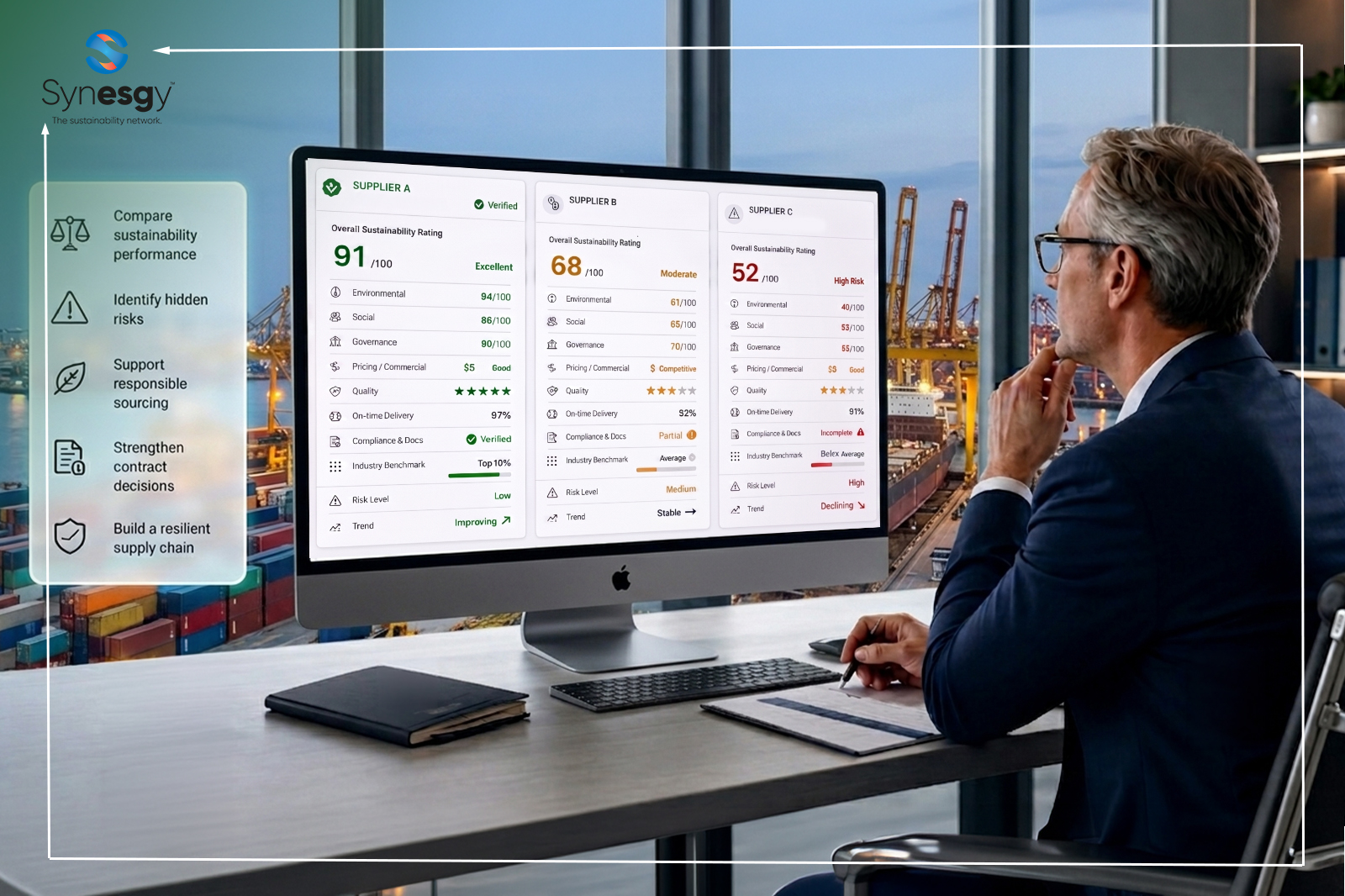
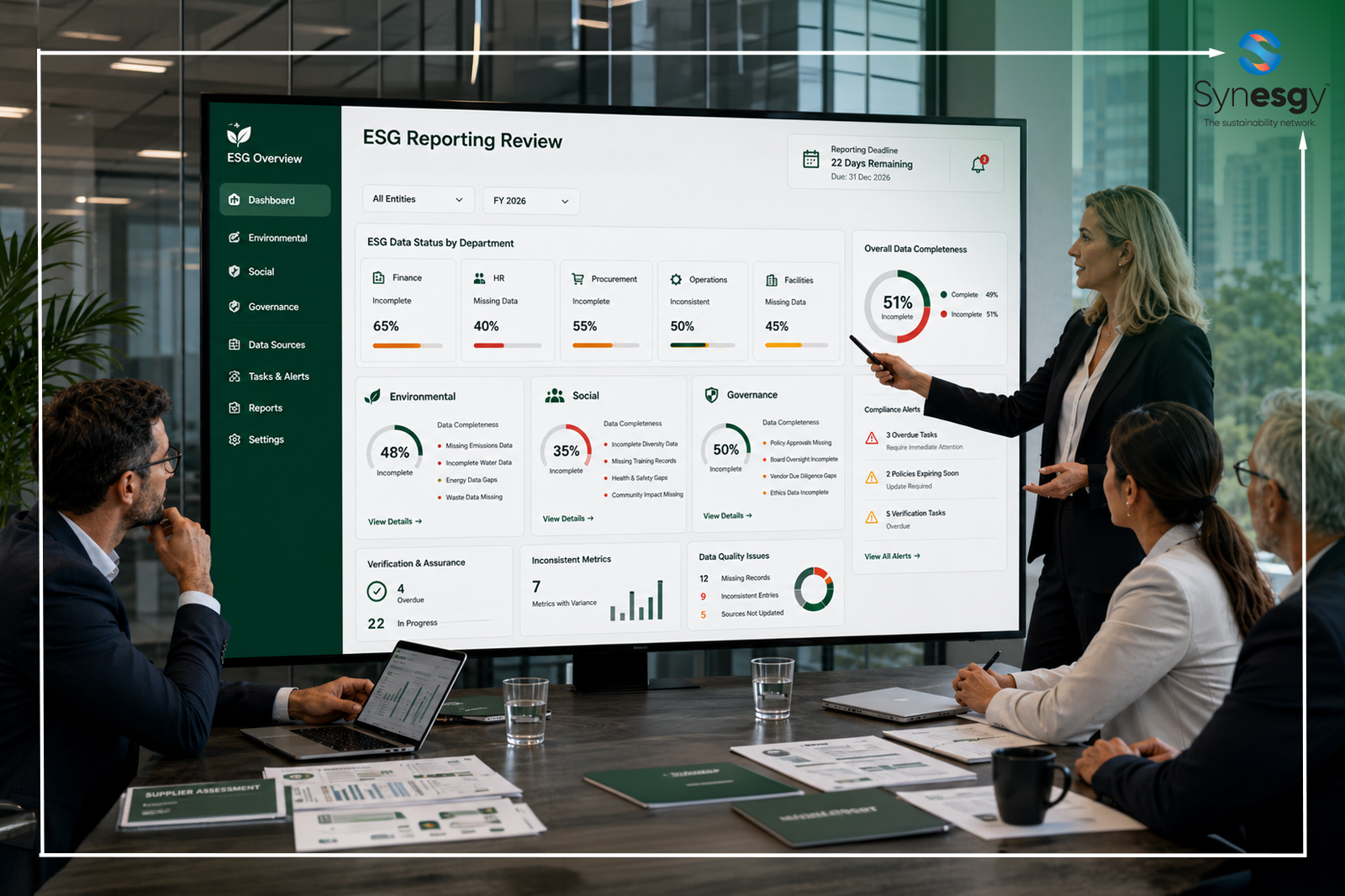
An ESG assessment platform is a digital solution that automates the process of evaluating ESG performance and compliance.
Key capabilities include:
-
Automated data collection and analysis
-
Real-time ESG scoring
-
Alignment with global frameworks
-
Simplified reporting and documentation
For UAE businesses, these platforms reduce manual effort and improve accuracy, making compliance faster and more efficient.
How Can Businesses Obtain an ESG Certificate in the UAE?
Obtaining an ESG certificate in the UAE involves:
-
Conducting a comprehensive ESG assessment
-
Aligning with recognized ESG frameworks
-
Improving ESG performance based on insights
-
Submitting data for verification
-
Receiving certification from an accredited platform
With solutions like Synesgy, businesses can streamline this process and achieve certification more efficiently.
An ESG certificate helps organizations:
-
Demonstrate compliance and transparency
-
Enhance brand credibility
-
Qualify for government tenders and partnerships
Key Takeaways
-
Regulatory compliance assessments are essential for UAE businesses to meet legal, financial, and sustainability requirements.
-
ESG compliance is now a core part of compliance, not a separate function.
-
Global frameworks like GRI, IFRS S1 S2, and CSRD are shaping ESG reporting standards in the UAE.
-
Conducting an ESG risk assessment helps identify gaps and improve overall compliance performance.
-
A strong ESG score in the UAE enhances investor confidence, brand reputation, and business credibility.
-
ESG assessment platforms simplify data collection, reporting, and compliance processes through automation.
-
Achieving an ESG certificate in the UAE supports transparency, regulatory alignment, and growth opportunities.
Conclusion
As regulatory expectations and sustainability demands continue to evolve, regulatory compliance assessments are becoming essential for businesses operating in the UAE. The integration of ESG compliance into these assessments reflects a broader shift toward responsible and transparent business practices.
By adopting structured compliance processes, aligning with global ESG reporting frameworks, and leveraging advanced ESG assessment platforms, companies can not only meet regulatory requirements but also strengthen their competitive position.
Simplify ESG compliance. Strengthen your business. Get started with Synesgy today.
FAQs
Q: What is included in a regulatory compliance assessment?
A: It includes legal, financial, operational, and ESG evaluations to ensure a business meets all applicable standards. This typically involves reviewing regulatory filings, internal policies, risk controls, governance practices, and sustainability disclosures to identify compliance gaps and improvement areas.
Q: How often should companies conduct compliance assessments in the UAE?
A: Most companies conduct them annually, though high-risk industries such as finance, healthcare, and energy may require more frequent assessments. Regular assessments help businesses stay aligned with evolving UAE regulations and global ESG standards.
Q: What are the risks of non-compliance in the UAE?
A: Risks include financial penalties, legal consequences, and reputational damage. In addition, non-compliance can lead to loss of business opportunities, reduced investor confidence, and difficulties in securing partnerships or government contracts.
Q: What is the difference between ESG compliance and ESG risk assessment?
A: ESG compliance ensures adherence to environmental, social, and governance standards and regulatory requirements. ESG risk assessment, on the other hand, focuses on identifying and evaluating potential sustainability-related risks that could impact business performance and long-term stability.
Q: How is an ESG score calculated in the UAE?
A: It is based on environmental, social, and governance performance metrics such as emissions, resource usage, workforce practices, and corporate governance. These factors are analyzed and benchmarked against industry standards to provide a measurable ESG score that reflects overall sustainability performance.
Q: What is GRI compliance assessment and why is it important?
A: A GRI compliance assessment evaluates sustainability reporting based on Global Reporting Initiative standards. It ensures transparency, consistency, and global comparability of ESG data, making it easier for stakeholders and investors to assess a company’s sustainability efforts.
Q: Does CSRD apply to UAE-based companies?
A: CSRD primarily applies to companies operating within the European Union. However, UAE-based companies with EU subsidiaries, listings, or significant business exposure to the EU may need to comply with CSRD requirements to meet reporting obligations.
Q: What documents are required for ESG compliance assessments?
A: Documents typically include financial reports, sustainability data, governance policies, risk management frameworks, and operational records. Companies may also need to provide ESG disclosures, environmental impact data, and internal audit reports.
Q: How long does an ESG compliance assessment take?
A: It can take a few weeks to a few months depending on the size, complexity, and data readiness of the organization. Businesses with structured reporting systems and digital tools can complete assessments more efficiently.
Q: Is ESG certification required for companies in the UAE?
A: It is not mandatory but is becoming increasingly important. ESG certification enhances credibility, supports investor decision-making, improves access to funding, and strengthens eligibility for government tenders and partnerships.