With the UAE formalizing ESG disclosure requirements, companies are entering a more structured and regulated compliance environment. The transition toward mandatory ESG reporting UAE is being driven by evolving frameworks such as Federal Decree-Law No. 11 of 2024, alongside directives from the Securities and Commodities Authority and stock exchanges.
As 2026 approaches, businesses, especially publicly listed entities, must ensure their reporting practices are aligned with regulatory expectations, global standards, and emissions monitoring requirements. This shift increases the importance of structured regulatory compliance assessments to ensure accuracy, transparency, and audit readiness.
What Is Driving ESG Reporting Requirements in the UAE by 2026?
ESG reporting requirements in the UAE are shaped by a combination of regulatory frameworks rather than a single unified law. These include the Federal Decree-Law No. 11 of 2024, which mandates emissions tracking and reporting, along with guidelines issued by the Securities and Commodities Authority.
In addition, stock exchanges such as the Dubai Financial Market and the Abu Dhabi Securities Exchange have established ESG disclosure requirements for listed companies. Together, these frameworks define the UAE’s ESG reporting landscape, setting clear expectations for transparency, accountability, and sustainability performance.
Is ESG reporting mandatory in the UAE for listed companies?
Yes. ESG reporting is mandatory for companies listed on major UAE exchanges such as the Dubai Financial Market and the Abu Dhabi Securities Exchange, where disclosures must be submitted annually.
Who must comply with ESG reporting requirements in the UAE?
Currently, compliance directly applies to:
-
Publicly listed companies
-
Entities regulated by UAE financial authorities
While ESG expectations may influence supply chains, mandatory obligations are not yet universally enforced across SMEs.
What Are the ESG Reporting Requirements for UAE Companies?
The ESG reporting requirements UAE are structured around Environmental, Social, and Governance disclosures.
Environmental
-
Scope 1 and Scope 2 emissions reporting
-
Energy consumption and efficiency
-
Environmental impact tracking
Social
-
Workforce diversity and inclusion
-
Employee health and safety
-
Community engagement
Governance
-
Board structure and oversight
-
Ethics and anti-corruption policies
-
Risk management frameworks
Companies must ensure that ESG disclosures are measurable, consistent, and aligned with internationally recognized standards.
Which Companies Must Comply with ESG Reporting in the UAE?
As ESG regulations become more structured in the UAE, it is important for businesses to clearly understand whether they fall within the scope of mandatory reporting. While requirements are currently focused on listed entities, the expectations around transparency and disclosure are becoming increasingly defined across regulated markets.
Do DFM and ADX require ESG reporting for listed companies?
Yes. Both the Dubai Financial Market and the Abu Dhabi Securities Exchange require ESG disclosures as part of annual reporting.
Are sustainability reports required with annual financial reports in the UAE?
Yes. ESG disclosures are typically submitted:
-
As part of the annual reports
-
Or as standalone sustainability reports
These must usually be filed within ~90 days of the financial year-end or before the AGM.
What must publicly listed companies disclose?
Companies must provide:
-
ESG performance metrics
-
Sustainability strategies
-
Risk exposure related to ESG factors
-
Governance practices
This ensures transparency for investors and regulators while aligning with UAE sustainability laws.
How Does ESG Reporting Align with Global Standards?
UAE regulations encourage alignment with global frameworks such as:
-
TCFD (climate-related disclosures)
-
IFRS S1 and S2 (emerging global baseline)
Is ISSB mandatory for ESG reporting in the UAE?
No. ISSB standards are not mandatory, but are strongly recommended for global comparability and investor confidence.
How does UAE ESG reporting align globally?
The UAE aims to position itself as a global sustainability leader by harmonizing local regulations with international frameworks. This alignment enhances investor confidence and facilitates cross-border investment.
How to Prepare for ESG Reporting Compliance in the UAE
Preparing for ESG compliance requires a structured and proactive approach.
Key Steps:
-
Conduct ESG Readiness Assessment
Evaluate current ESG practices and identify gaps.
-
Establish Data Collection Systems
Capture ESG metrics across departments.
-
Select Reporting Frameworks
Align with GRI, ISSB, or TCFD standards.
-
Implement Governance Structures
Assign ESG responsibilities across leadership teams.
-
Enable Continuous Monitoring
Track performance and update reports regularly.
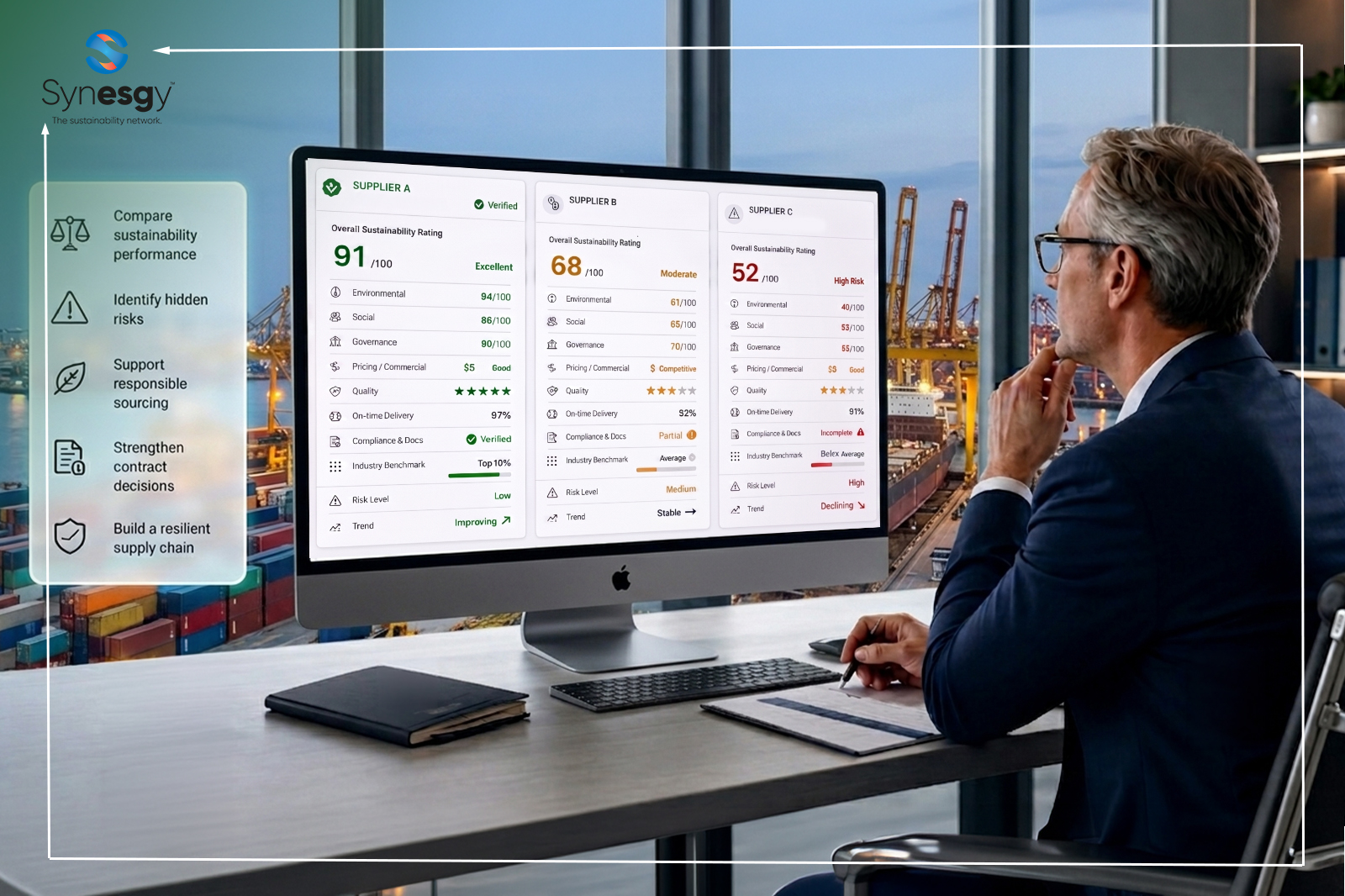
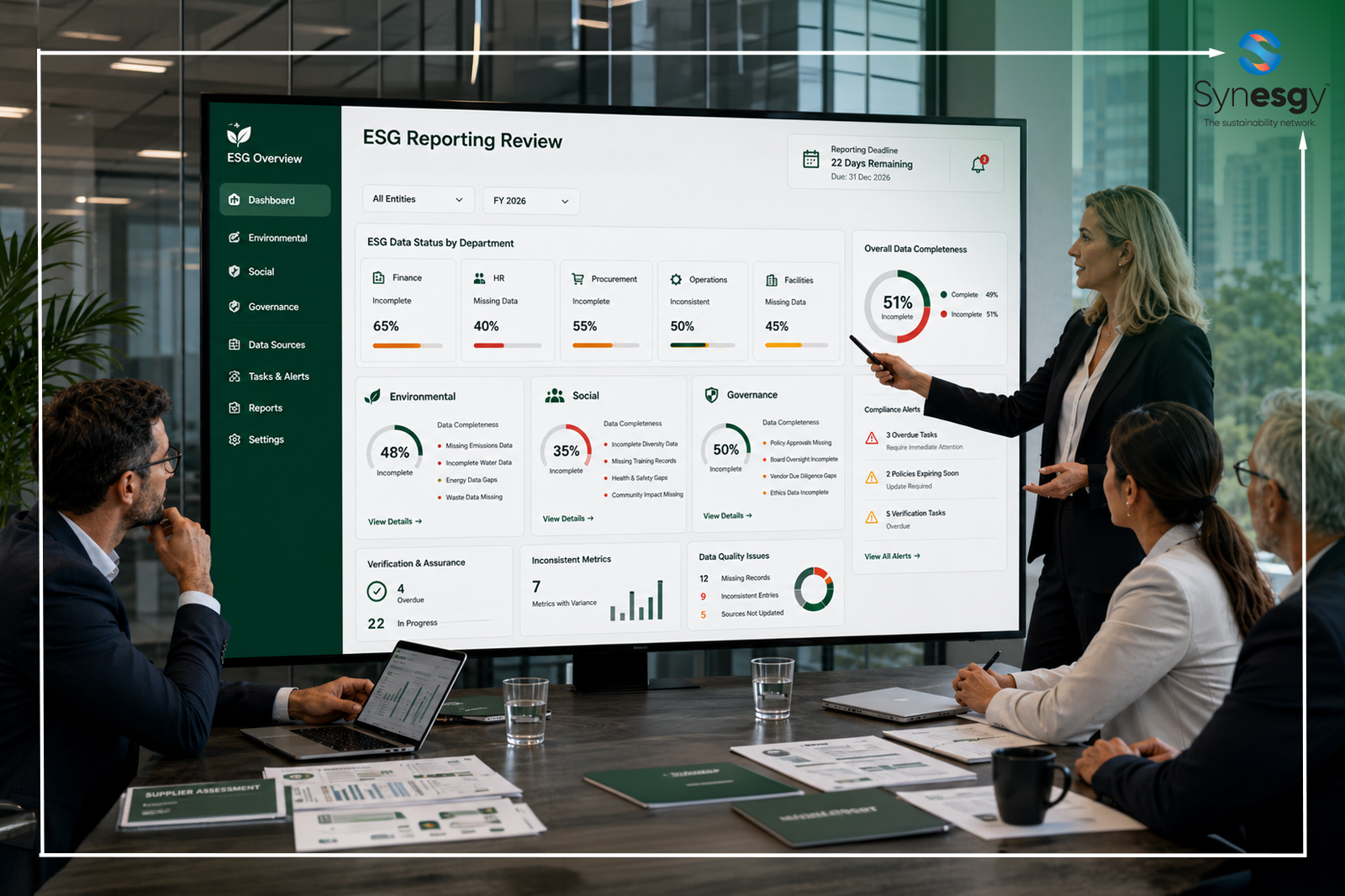
This is where an ESG scoring platform and advanced ESG rating tools play a critical role. Solutions like Synesgy help businesses centralize ESG data, automate reporting, and generate standardized ESG scores.
How Regulatory Compliance Assessments Support ESG Reporting
Regulatory compliance assessments are essential for ensuring that ESG reporting meets both local and international standards.
What is the difference between ESG reporting and regulatory compliance assessments?
-
ESG reporting focuses on disclosing sustainability performance
-
Compliance assessments ensure that disclosures meet regulatory requirements
How do compliance assessments support ESG reporting?
They help:
-
Identify compliance gaps
-
Validate ESG data
-
Ensure alignment with UAE sustainability laws
-
Reduce regulatory and operational risks
How to conduct regulatory compliance assessments?
-
Perform internal audits
-
Benchmark against regulatory standards
-
Use automated ESG platforms
-
Engage third-party verification if needed
Platforms like Synesgy simplify this process by offering integrated ESG audit and compliance capabilities, enabling businesses to monitor and improve their ESG performance continuously.
What Are the Deadlines, Penalties, and Risks of Non-Compliance?
As ESG regulations in the UAE continue to evolve, understanding compliance timelines and associated risks is critical. Companies must not only meet reporting deadlines but also ensure their disclosures are accurate and aligned with regulatory expectations to avoid financial, legal, and reputational consequences.
What is the deadline for ESG reporting compliance in the UAE?
ESG disclosure requirements have been phased in since 2024. Full alignment with climate reporting and global frameworks is expected by 2026.
What happens if companies fail ESG compliance?
Non-compliance can result in:
-
Financial penalties
-
Regulatory sanctions
-
Reputational damage
-
Loss of investor confidence
What are the penalties under UAE sustainability laws?
Penalties may include fines, operational restrictions, or increased scrutiny from regulators. Failing to meet ESG obligations also impacts access to capital and business partnerships, making compliance a strategic necessity.
How ESG Reporting Impacts Business Strategy and Risk in the UAE
While ESG reporting is often viewed as a compliance requirement, its impact extends far beyond regulatory obligations. In the UAE, it is increasingly becoming a strategic tool that helps businesses strengthen governance, identify risks early, and build long-term stakeholder trust.
Why is ESG reporting important for regulatory compliance in the UAE?
It ensures transparency, accountability, and alignment with national sustainability goals.
How does ESG reporting reduce business risk?
-
Identifies environmental and operational risks
-
Strengthens governance and oversight
-
Improves decision-making through structured data
How does ESG reporting improve corporate transparency?
It provides stakeholders with clear insights into company practices, improving trust and credibility.
What does every publicly listed company must do for ESG reporting in UAE by 2026?
To meet evolving ESG reporting UAE requirements, publicly listed companies must move beyond basic disclosures and adopt a structured, compliance-driven approach. This involves building robust internal systems, ensuring data accuracy, and aligning with both regulatory expectations and global standards.
Publicly listed companies must:
-
Establish structured ESG data collection systems
Implement centralized processes to capture, validate, and manage ESG data across departments, ensuring consistency and audit readiness.
-
Report Scope 1 and Scope 2 emissions
Accurately measure and disclose direct and indirect emissions in line with national climate reporting requirements and monitoring frameworks.
-
Align with recognized global frameworks
Follow standards such as GRI, TCFD, and IFRS S1/S2 to ensure disclosures are comparable, transparent, and aligned with investor expectations.
5. Submit ESG disclosures annually within required timelines
Integrate ESG reporting into annual disclosures, typically within regulatory timelines (such as pre-AGM or within 90 days of the financial year-end).
6. Conduct periodic regulatory compliance assessments
Regularly review ESG processes and disclosures to identify gaps, ensure alignment with UAE sustainability laws, and reduce the risk of non-compliance.
7. Strengthen internal governance and accountability
Assign clear ownership of ESG responsibilities at leadership and operational levels to ensure consistent oversight and reporting accuracy.
8. Maintain documentation and audit trails
Ensure all ESG disclosures are supported by verifiable records, enabling smooth audits and third-party validation if required.
Key Takeaways
-
ESG reporting UAE is mandatory for listed companies, driven by multiple regulatory frameworks
-
ESG disclosures must be submitted annually with financial reports
-
IFRS S1/S2 and global frameworks are recommended, not always mandatory
-
Non-compliance can result in fines up to AED 2 million
-
Regulatory compliance assessments are essential for ensuring accuracy and readiness
Conclusion
The UAE’s ESG regulatory landscape is evolving rapidly, with increasing emphasis on transparency, accountability, and climate responsibility. For publicly listed companies, ESG reporting is no longer optional but a core compliance requirement tied to regulatory approval and investor confidence.
Organizations that take a structured approach, focusing on accurate data collection, alignment with global frameworks, and ongoing compliance monitoring, will be better positioned to navigate this transition successfully. As 2026 approaches, proactive preparation will be key to minimizing risks and maintaining competitiveness in an increasingly sustainability-driven market.
Take control of your ESG reporting UAE journey today. Start your ESG assessment with Synesgy and stay ahead of compliance in 2026.
FAQs
Q: What documents are required for ESG compliance reporting in the UAE?
A: Organizations typically need sustainability or ESG reports, emissions data (Scope 1 and Scope 2), governance policies, risk management frameworks, audit records, and operational data. Supporting documentation that validates ESG disclosures is essential for ensuring credibility and meeting ESG audit and compliance requirements.
Q: Do UAE companies need third-party verification for ESG reports?
A: Third-party verification is not always mandatory but is increasingly expected by investors and regulators. Independent validation improves data accuracy, strengthens credibility, and supports better benchmarking, especially for companies using ESG scoring platforms and seeking global alignment.
Q: How often must ESG reports be submitted in the UAE?
A: Most publicly listed companies are required to submit ESG disclosures annually, typically alongside financial reports. However, some sectors may require more frequent internal monitoring to ensure continuous compliance and readiness for audits or regulatory reviews.
Q: What are Scope 1 and Scope 2 emissions reporting requirements in the UAE?
A: Scope 1 emissions refer to direct emissions from owned or controlled operations, while Scope 2 includes indirect emissions from purchased electricity, heating, or cooling. Both are critical components of ESG reporting UAE, helping organizations measure and manage their carbon footprint effectively.
Q: How does the UAE Climate Law affect ESG reporting in 2026?
A: The UAE Climate Law introduces mandatory emissions tracking, reporting, and reduction strategies. It reinforces ESG reporting as a legal obligation, requiring companies to integrate sustainability into core operations and ensure compliance with national climate goals.
Q: Which UAE authorities regulate ESG reporting?
A: ESG reporting is overseen by financial market regulators, environmental authorities, and federal governance bodies. These entities set disclosure standards, monitor compliance, and enforce UAE sustainability laws across listed companies and regulated industries.
Q: What is the best ESG reporting framework for UAE companies?
A: Widely adopted frameworks include GRI, ISSB, and TCFD, each offering structured guidelines for ESG disclosures. The best framework depends on industry requirements, regulatory expectations, and investor needs, with many companies combining multiple standards for comprehensive reporting.