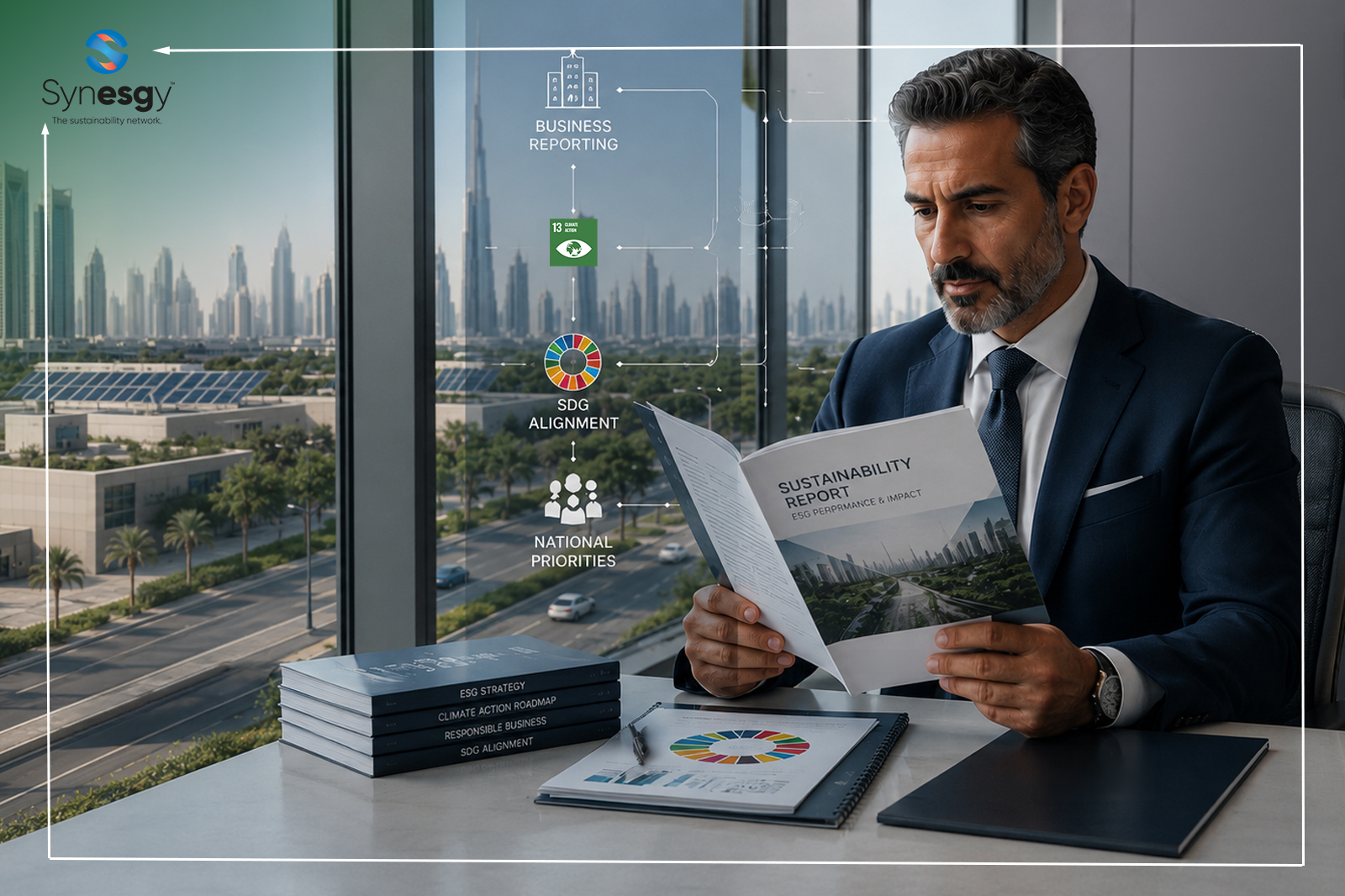
SDG reporting for businesses is no longer just a values-driven exercise carried out for the benefit of a company’s own sustainability narrative. Increasingly, it intersects directly with national policy priorities, particularly in the UAE, where sustainability has become a defined part of long-term economic strategy. For businesses trying to understand where SDG reporting fits into this bigger picture, the connection is worth unpacking in detail, since it changes how reporting should be approached and why it matters beyond internal compliance.
This article looks at what SDG reporting involves, how it connects to national sustainability strategy in the UAE, and what businesses should consider as they build or refine their own reporting practices. If your business is looking to strengthen its sustainability reporting approach, a structured ESG assessment can help identify where SDG alignment currently stands.
Understand how closely your current sustainability practices align with the SDGs. Start with a structured Synesgy ESG assessment.
What Is SDG Reporting and Why Does It Matter for Businesses?
SDG reporting for businesses refers to the practice of measuring and disclosing how a company’s activities contribute to the United Nations Sustainable Development Goals, a set of seventeen global objectives covering areas such as climate action, decent work, gender equality, and responsible consumption. Unlike general sustainability reporting, SDG reporting maps specific business outcomes to specific global targets, giving stakeholders a clearer sense of where a company’s efforts fit within a recognized international framework.
This distinguishes SDG reporting somewhat from broader ESG disclosure, which tends to focus on risk and performance across environmental, social, and governance categories without necessarily tying outcomes to a specific external framework. Sustainable development goals reporting adds a layer of external alignment, helping stakeholders compare a company’s contributions against a globally recognized standard rather than an internally defined one. For many businesses, this makes SDG reporting a useful complement to existing ESG disclosure, rather than a replacement for it.
How Does the UAE Approach National Sustainability Strategy?
The UAE has positioned sustainability as a defined pillar of national economic strategy rather than treating it as a standalone environmental initiative. This is reflected in the UAE’s continued investment in renewable energy, its stated net zero targets, and its broader economic diversification agenda, all of which connect sustainability to long-term national competitiveness rather than framing it purely as an environmental obligation.
This national sustainability agenda extends into how the UAE positions itself internationally as well. By aligning economic policy with recognized global sustainability frameworks, the UAE has worked to strengthen its standing with international investors and trading partners who increasingly expect sustainability performance to be measurable against common benchmarks. This context matters for businesses because it shapes the expectations placed on them, both from government stakeholders and from private sector partners who take their cues from national direction.
How Does the UAE Ministry of Economy Support SDG Alignment?
The UAE’s approach to the Sustainable Development Goals is not limited to broad policy statements. The Ministry of Economy and Tourism maintains a dedicated resource outlining the UAE’s approach to the Sustainable Development Goals, detailing how the goals are integrated into national planning and economic policy. This gives businesses a concrete government reference point for understanding how SDG alignment is treated at a national level, rather than relying solely on international interpretations of the goals.
For companies building their own SDG reporting practices, this matters because it establishes that SDG alignment in the UAE is not simply an imported international standard applied without local context. It is actively supported and interpreted at a government level, which creates a stronger case for private sector reporting to mirror this national direction rather than developing SDG frameworks in isolation. Businesses that reference this alignment in their own reporting are effectively demonstrating that their sustainability efforts sit within a recognized national structure, which can strengthen credibility with both regulators and investors.
This also creates a practical opportunity. Businesses working through public private sustainability partnerships, or those seeking to work with government-linked entities, are increasingly expected to show that their sustainability commitments are not disconnected from national priorities. Government sustainability priorities set the tone, and businesses that can clearly map their own SDG reporting against this direction tend to find it easier to build trust with public sector partners.
How Does SDG Reporting Connect to ESG Disclosure?
For businesses already producing ESG disclosures, SDG reporting does not need to be built from scratch as a separate exercise. Integrated sustainability reporting, where ESG metrics are mapped against relevant SDG targets, allows companies to extend existing reporting practices rather than duplicating effort across two parallel systems.
In practice, this usually means reviewing existing ESG data, such as emissions figures, workforce diversity metrics, or governance disclosures, and identifying which SDG targets they naturally correspond to. A company already reporting on emissions reduction, for example, can map this directly to SDG 13 on climate action, while workforce-related ESG metrics often align closely with SDG 8 on decent work and economic growth. This kind of ESG and SDG alignment tends to be more efficient than treating the two as entirely separate reporting obligations, and it also produces a clearer, more externally recognizable narrative for stakeholders reviewing the report.
Turn your existing ESG data into a more structured SDG-aligned report. Synesgy can help identify relevant goals, metrics, and reporting gaps.
Why Should Businesses Align Reporting With National Sustainability Goals?
Aligning company-level SDG reporting with national sustainability targets carries both reputational and commercial advantages. Businesses that can clearly demonstrate how their sustainability efforts contribute to broader national priorities tend to find it easier to build credibility with government-linked partners, particularly where public sector contracts or partnerships are involved.
There is also a growing expectation, particularly among larger commercial partners and financial institutions, that businesses show some form of private sector sustainability contribution beyond internally defined metrics. Aligning with national sustainability targets gives businesses an external, recognizable benchmark to point to, rather than relying solely on self-defined sustainability claims that can be harder for external parties to verify or compare.
This alignment can also support access to sustainable finance instruments, since lenders and investors increasingly look for evidence that a company’s sustainability reporting reflects recognized frameworks rather than ad hoc internal metrics. If your business is exploring how to strengthen this alignment, a structured sustainability assessment can help identify where current reporting practices already connect to national priorities and where gaps remain.
How Can Businesses Start SDG Reporting?
Businesses beginning SDG reporting for the first time are generally better served starting with a small, focused set of goals rather than attempting to report against all seventeen at once. The most effective starting point is usually SDG goal mapping, where a company reviews its core business activities and identifies which SDGs are most directly relevant to its operations, rather than selecting goals based on popularity or general appeal.
From there, sustainability KPI tracking becomes the practical foundation of ongoing reporting. This means identifying measurable indicators tied to each prioritized SDG, whether that involves emissions data, workforce metrics, or community investment figures, and building consistent tracking processes so that reporting reflects real performance rather than static commitments. SDG performance tracking works best when it is built into existing data collection processes rather than treated as an annual, standalone reporting exercise.
It is also worth resisting the temptation to claim alignment with SDGs that are only loosely connected to core business activities. Reporting against a narrow, genuinely relevant set of goals tends to carry more credibility with stakeholders than broad claims of contribution across areas where a business has limited actual influence.
Build a credible SDG reporting strategy based on measurable impact, not broad or unsupported sustainability claims.
How Does SDG Reporting Affect Investor and Stakeholder Confidence?
Investor sustainability expectations have shifted considerably over the past several years, with many investors now looking for evidence that goes beyond general ESG scores. SDG reporting provides a more specific, internationally recognized reference point that can help investors assess how a company’s sustainability efforts align with broader global priorities, rather than relying purely on internally defined ESG metrics.
Stakeholder transparency benefits from this approach as well. Employees, customers, and business partners increasingly expect companies to demonstrate measurable sustainability outcomes rather than general statements of intent. SDG reporting, when done well, gives these stakeholders a clearer, more structured way to evaluate a company’s actual contributions.
This growing expectation also connects to sustainable finance alignment, since financial institutions offering sustainability-linked lending products increasingly ask for evidence of structured, externally benchmarked reporting. Businesses that already have SDG reporting in place tend to find these conversations considerably more straightforward than those still relying solely on internal sustainability claims.
What Should Businesses Expect Next in SDG Reporting?
As the UAE continues to formalize its national sustainability strategy, businesses should expect SDG reporting expectations to become more structured over time, even if formal mandates remain limited for now. Economic diversification UAE priorities continue to place sustainability at the center of long-term competitiveness, which suggests that alignment with recognized frameworks like the SDGs will likely move from a differentiator to a baseline expectation, particularly for businesses working with government-linked partners or seeking access to sustainable finance.
Businesses that begin building sustainable business practices UAE regulators and partners increasingly expect, ahead of formal requirements, will be better positioned to adapt smoothly as expectations continue to develop. Waiting until SDG-aligned reporting becomes a stated requirement typically means adapting under pressure, while businesses that build this capability early are able to shape their reporting approach around what genuinely reflects their operations.
Conclusion
SDG reporting is increasingly less about voluntary goodwill and more about demonstrating alignment with a national sustainability direction that the UAE has clearly defined at a government level. Businesses that connect their own SDG reporting to this broader national strategy, rather than treating it as a separate, disconnected exercise, tend to build stronger credibility with investors, government-linked partners, and stakeholders who increasingly expect measurable, externally benchmarked sustainability performance.
As national sustainability priorities continue to shape business expectations, companies that start building structured SDG reporting practices now will be better positioned than those waiting for formal requirements to catch up with them.
If your business is ready to strengthen its sustainability reporting and align it more closely with national priorities, Synesgy’s ESG assessment can help identify where your current reporting stands and what to prioritize next.
FAQs
Q: What is SDG reporting?
A: SDG reporting is the practice of measuring and disclosing how a company’s activities contribute to the United Nations Sustainable Development Goals, mapping specific business outcomes to specific global targets rather than reporting against internally defined metrics alone.
Q: Why do businesses report against the SDGs?
A: Businesses report against the SDGs to demonstrate measurable, externally recognized contributions to global sustainability priorities, which helps build credibility with investors, stakeholders, and government-linked partners.
Q: How is SDG reporting different from ESG reporting?
A: ESG reporting typically covers environmental, social, and governance performance based on internally or industry-defined metrics, while SDG reporting maps specific outcomes to a recognized international framework, making it easier to benchmark against globally accepted goals.
Q: Is SDG reporting mandatory for UAE businesses?
A: SDG reporting is not currently mandatory for most UAE businesses, though national sustainability priorities and growing stakeholder expectations suggest structured alignment with the SDGs is likely to become more expected over time.
Q: How does the UAE government support businesses in aligning with the SDGs?
A: The UAE Ministry of Economy and Tourism maintains a dedicated resource outlining the country’s national approach to the Sustainable Development Goals, giving businesses a government-level reference point to align their own reporting with national priorities.
Q: Can a business use its existing ESG reporting to support SDG reporting?
A: Yes. Many ESG metrics, such as emissions data or workforce diversity figures, can be mapped directly to relevant SDG targets, allowing businesses to extend existing reporting practices rather than building an entirely separate SDG reporting process.
Q: Which SDGs should a business prioritize first?
A: Businesses generally get the most value from prioritizing a small number of SDGs that are most directly relevant to their core operations, rather than attempting to report against all seventeen goals at once.
Q: How does SDG reporting affect a company’s ability to attract investment?
A: Investors increasingly look for evidence of structured, externally benchmarked sustainability reporting. Businesses with clear SDG-aligned reporting tend to find it easier to demonstrate credibility during financing discussions or sustainability-linked lending applications.