Sustainability performance used to sit almost entirely under a regulatory umbrella. Companies collected data, filed reports, and moved on. That approach is changing. Businesses that treat sustainability performance as a strategic tool, not a filing requirement, are seeing measurable gains in efficiency, resilience, and stakeholder trust.
This shift matters because compliance sets a floor, not a ceiling. Meeting minimum reporting obligations tells a regulator what happened last year. Measuring sustainability performance properly tells a business what is happening now and what to do next. This article looks at what sustainability performance actually means, how it is measured, and why companies that go beyond compliance are building a real competitive advantage.
Ready to move beyond checkbox reporting? Start with a structured sustainability assessment with Synesgy to understand your current performance, risks, and improvement opportunities.
What Is Sustainability Performance
Sustainability performance refers to the measurable outcomes of a company’s environmental, social, and governance activities. It covers everything from energy consumption and waste management to labor practices and governance structures. The keyword is measurable. Sustainability performance is not a mission statement or a set of intentions. It is data.
It helps to separate two things that often get blended together: sustainability reporting and sustainability performance. Reporting is the disclosure, the document that gets shared with regulators, investors, or the public. Performance is the underlying reality that the report describes. A company can have excellent reporting practices and mediocre performance, or the reverse. The businesses that benefit most are the ones that treat performance measurement as an internal management discipline first, with reporting as a downstream output rather than the primary goal.
Why Measure Sustainability Performance
There are three overlapping reasons companies measure sustainability performance today, and they rarely act alone.
The first is regulatory. Governments and industry bodies continue to expand sustainability disclosure requirements, and measurement is the starting point for meeting them. But treating this as the only reason to measure sustainability performance is a missed opportunity. Compliance is the floor, not the strategy.
The second reason is stakeholder pressure. Customers, employees, and supply chain partners increasingly expect visibility into how a company operates, not just what it sells. Large buyers now routinely ask suppliers for sustainability data before signing contracts. Employees, particularly younger hires, factor a company’s environmental and social record into where they choose to work. This pressure is not going away, and companies without data to show are at a disadvantage.
The third reason is internal. You cannot manage what you do not measure. Sustainability performance data reveals inefficiencies, resource waste, and risk exposure that would otherwise stay invisible. A company that tracks energy use across its facilities will find savings opportunities that a company relying on estimates never will.
Together, these three pressures push sustainability performance measurement from a compliance exercise into a genuine management tool.
How Is Sustainability Measured
Measuring sustainability performance means collecting data across three broad categories: environmental, social, and governance. Each category includes both quantitative indicators and qualitative indicators.
Quantitative indicators are the numbers: energy consumption, water use, emissions, waste volumes, workforce turnover rates. These are typically easier to track consistently over time because they come from operational systems that already exist, such as utility bills, HR records, and procurement data.
Qualitative indicators are structural: the existence of an anti-corruption policy, the presence of a formal grievance mechanism, the composition of a governance board. These are harder to quantify but equally important, since they reflect the systems that shape long-term outcomes rather than a single year’s numbers.
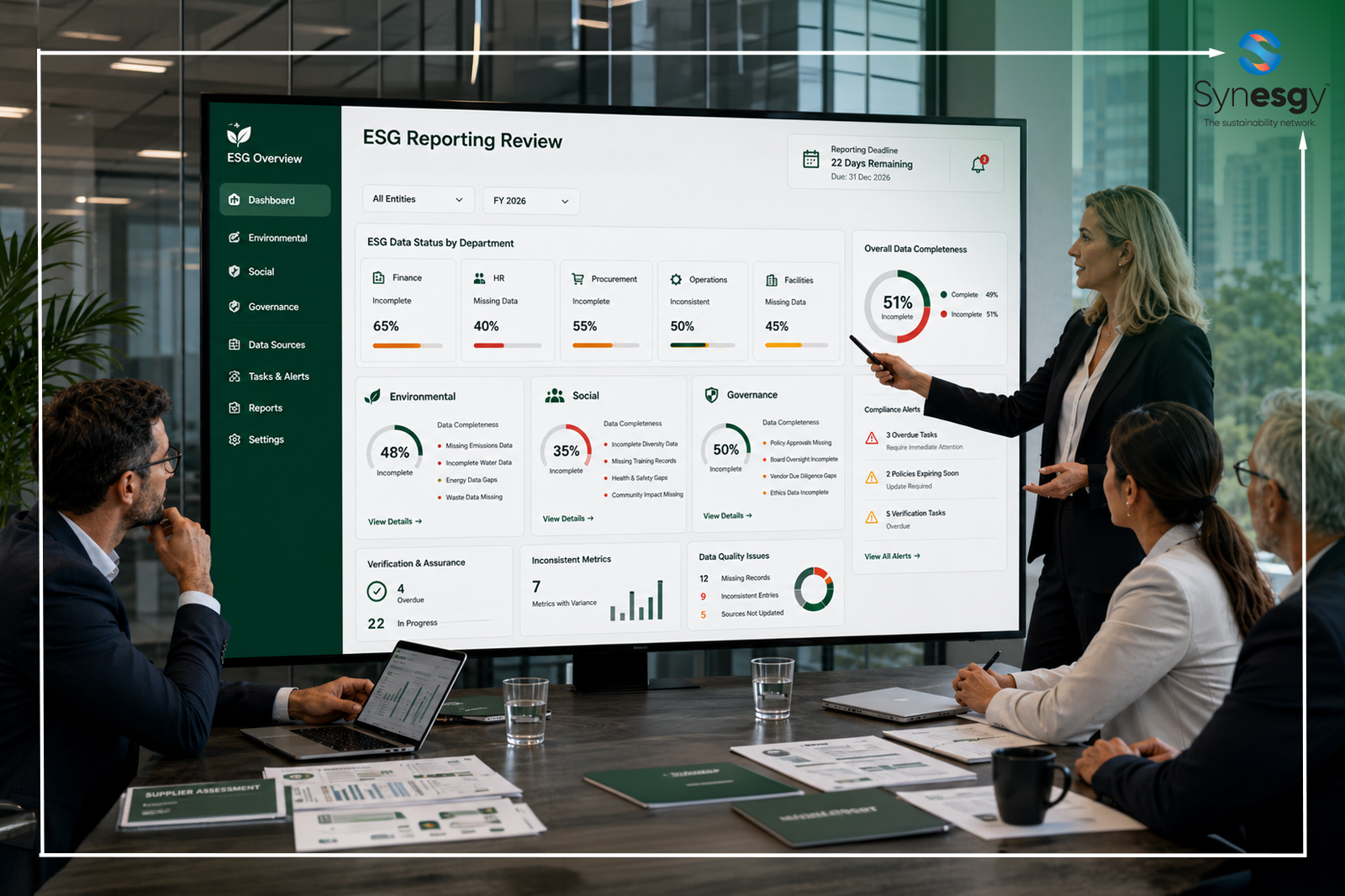
Before any meaningful benchmarking can happen, a company needs a baseline. Without a starting point, there is no way to demonstrate improvement or decline. This is where many companies stumble. They jump straight to setting targets or making public claims without first establishing where they actually stand. A structured assessment process, one that walks through environmental, social, and governance categories systematically, is the most reliable way to build that baseline and keep it consistent year over year.
What Are Sustainability KPIs
Key performance indicators, or KPIs, are the specific, trackable metrics a company uses to monitor sustainability performance over time. They translate broad categories like “environmental impact” into concrete numbers that can be tracked, compared, and reported.
On the environmental side, common KPIs include energy consumption per unit of output, water usage, waste diversion rates, and greenhouse gas emissions. On the social side, KPIs often cover employee turnover, workplace safety incidents, training hours per employee, and supplier labor practices. On the governance side, KPIs might include board diversity, the frequency of internal audits, or the existence and enforcement of ethics policies.
The mistake many companies make is adopting a generic list of KPIs pulled from an industry template without connecting them to their own business objectives. A manufacturing company and a professional services firm face entirely different sustainability risks, and their KPIs should reflect that. The most effective sustainability KPI sets are built around what actually drives risk and opportunity for that specific business, not a one-size-fits-all checklist.
How Do Companies Benchmark ESG Performance
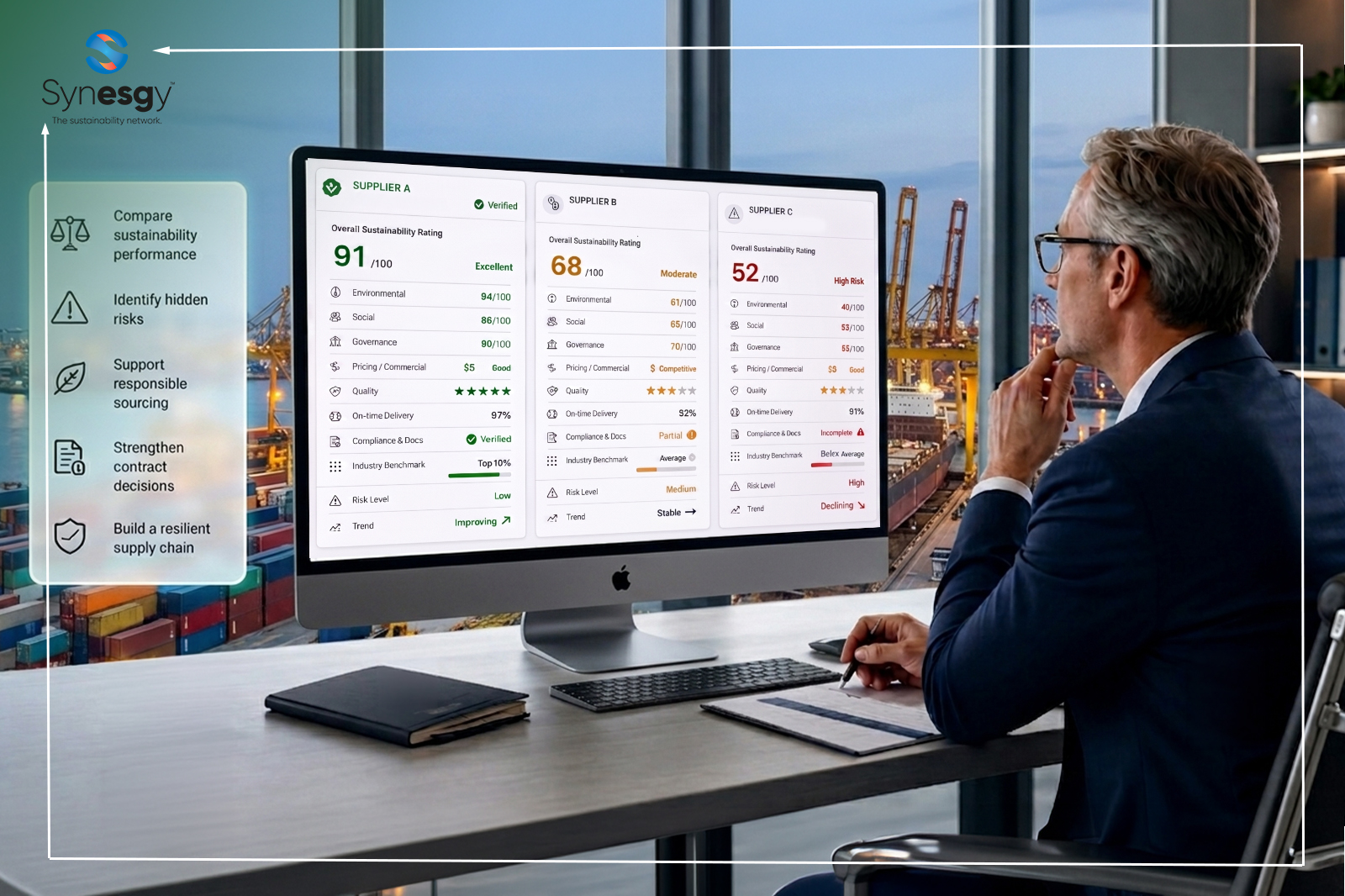
Benchmarking is the process of comparing a company’s sustainability performance against a reference point, whether that is industry peers, sector averages, or the company’s own historical data.
Benchmarking matters because raw numbers on their own do not tell you much. A company that reduced energy consumption by five percent looks good until you learn the industry average reduction was fifteen percent. Context turns a number into an insight.
One common pitfall is comparing performance without normalizing for company size, sector, or geography. A logistics company and a software company will never have comparable emissions profiles, and treating them as if they do produces misleading conclusions. Effective benchmarking accounts for these structural differences before drawing comparisons.
Benchmarking also is not a one-time exercise. Sustainability performance shifts year to year based on operational changes, market conditions, and regulatory developments. Companies that benchmark once and stop lose the ability to track whether their initiatives are actually working. Ongoing, consistent measurement is what makes benchmarking useful rather than just a snapshot.
Find out how your sustainability performance compares with relevant industry benchmarks using Synesgy. Start an assessment to uncover strengths, gaps, and priority improvement areas.
Does Sustainability Improve Profitability
This is the question that ultimately determines whether sustainability performance measurement gets budget and attention inside a company. The evidence points toward yes, though the mechanisms are often indirect rather than a straight line from measurement to revenue.
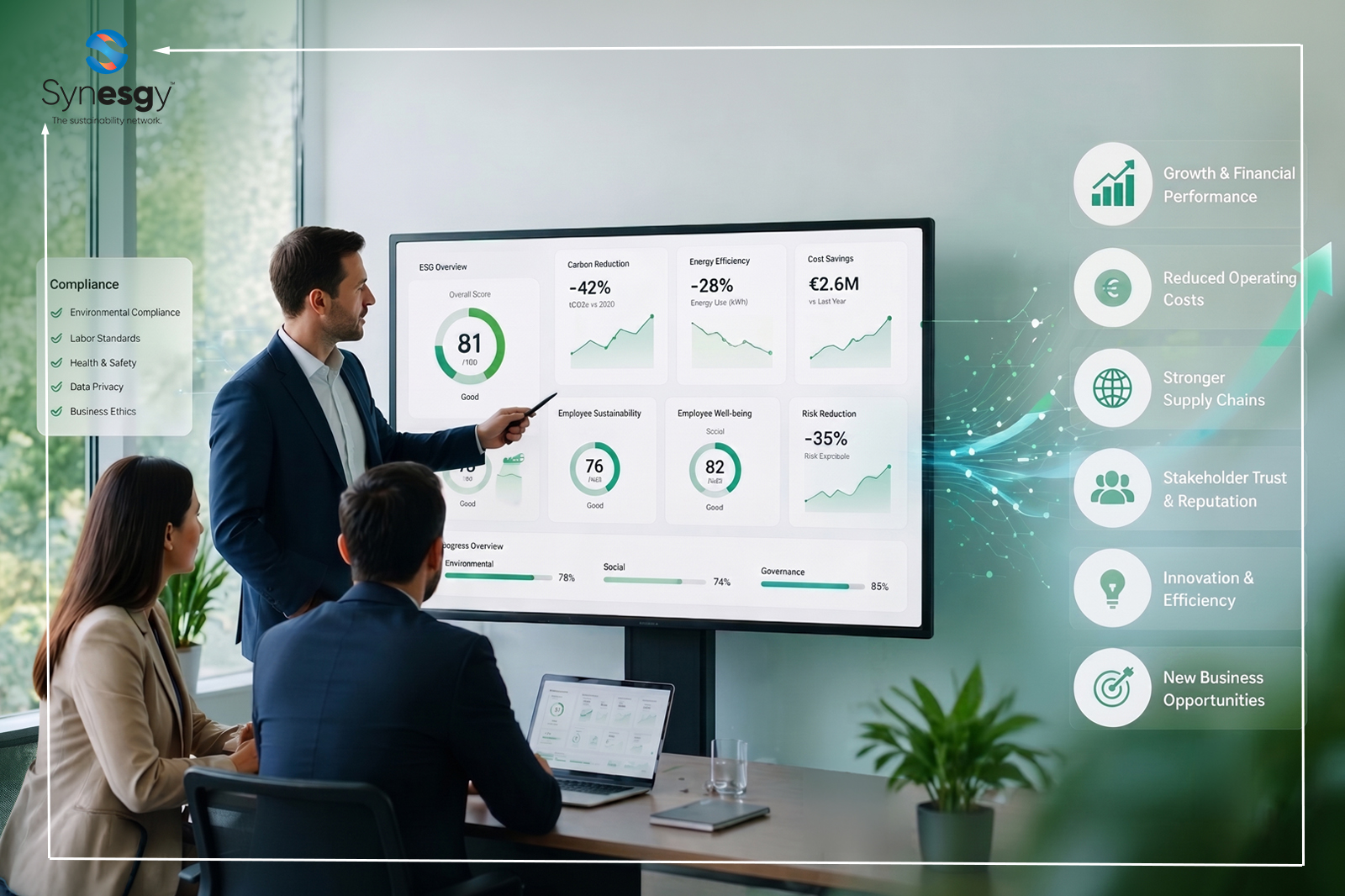
The clearest connection runs through operational efficiency. Measuring energy use, resource consumption, and waste generation routinely surfaces cost savings that would otherwise go unnoticed. Reducing energy consumption lowers utility costs. Reducing waste lowers disposal costs and, in many cases, raw material costs. These are direct, quantifiable savings that show up on a balance sheet.
The second connection is risk mitigation. Companies with strong sustainability performance are generally better positioned to avoid regulatory penalties, supply chain disruptions, and reputational damage. A supplier with poor labor practices or an unmanaged environmental liability represents a risk that can materialize suddenly and expensively. Measuring performance early gives a company the chance to address these risks before they become costly.
The third connection is access to capital. Investors and lenders increasingly incorporate sustainability performance into their decision-making, whether through formal due diligence processes or informal risk assessment. Companies that can produce credible sustainability data are better positioned to access financing on favorable terms, while companies that cannot may face higher scrutiny or reduced access altogether.
The fourth connection is retention, both of customers and business partners. Large buyers increasingly require sustainability data as part of procurement decisions. A company that cannot produce this data risks losing contracts to competitors who can.
None of these connections mean sustainability performance is a guaranteed profit driver on its own. But treated as a business resilience and risk management tool, backed by real measurement, it consistently correlates with better long-term financial outcomes.
Why Do Investors Care About Sustainability
Investors care about sustainability performance because it functions as a proxy for management quality and long-term risk exposure. A company that measures and manages its environmental, social, and governance performance well is generally signaling that it manages other aspects of the business well too.
Due diligence processes increasingly incorporate sustainability data as a standard part of investment evaluation, alongside financial statements and market analysis. Investors want to know whether a company faces hidden liabilities, whether its supply chain carries undisclosed risks, and whether its governance structures are robust enough to catch problems before they escalate.
Sustainability performance also factors into access to sustainable finance instruments, including green bonds and sustainability-linked loans, which often carry more favorable terms for companies that can demonstrate strong performance data.
This investor pressure does not stay contained to public markets. It filters down through supply chains, as large companies pass sustainability data requirements on to their suppliers, who in turn pass them on to smaller vendors. A company that has never dealt directly with an investor may still find itself needing sustainability performance data because a customer three steps up the supply chain requires it.
Conclusion
Sustainability performance measurement has moved well past its origins as a compliance obligation. Companies that measure consistently and use that data to inform real decisions see gains in operational efficiency, reduced risk exposure, stronger investor relationships, and better positioning with customers and supply chain partners who increasingly expect this data as standard practice.
The businesses still treating sustainability as an annual filing requirement are missing the larger opportunity. Measurement done well is a management tool, not a paperwork exercise, and the companies that recognize this early are the ones building lasting competitive advantage.
FAQs
Q: Why do investors care about sustainability performance?
A: Investors use sustainability performance data as a proxy for management quality and long-term risk exposure. Strong performance signals fewer hidden liabilities and better governance, which increasingly factors into due diligence, financing decisions, and access to sustainable finance instruments.
Q: How is sustainability performance different from sustainability reporting?
A: Sustainability performance refers to the actual measurable outcomes of a company’s environmental, social, and governance activities. Sustainability reporting is the document or disclosure that communicates those outcomes to regulators, investors, or the public. A company can report well while performing poorly, or the reverse.
Q: How often should a company measure its sustainability performance?
A: Sustainability performance should be measured on an ongoing basis, typically reviewed annually at minimum, rather than as a one-time exercise. Consistent, regular measurement is what allows a company to track progress, spot emerging risks, and demonstrate improvement over time to investors and partners.
Q: What happens if a company only measures sustainability performance for compliance?
A: Measuring only for compliance limits a company to meeting minimum regulatory requirements without gaining the operational insight that drives efficiency, risk reduction, or investor confidence. Companies that stop at compliance often miss cost savings and competitive advantages that come from deeper measurement.
Q: Can small and medium-sized businesses benefit from measuring sustainability performance?
A: Yes. Small and medium-sized businesses benefit from sustainability performance measurement through improved operational efficiency, stronger positioning with larger buyers who require supplier sustainability data, and better access to financing. Measurement does not require large scale to deliver value.
Q: What data do companies need to start measuring sustainability performance?
A: Companies typically start with existing operational data, such as utility bills for energy use, HR records for workforce metrics, and internal policies for governance indicators. A structured assessment helps organize this data into a consistent baseline for tracking and benchmarking.
Q: How does sustainability performance affect supply chain relationships?
A: Large buyers increasingly require sustainability performance data from suppliers as part of procurement decisions. Companies that can produce credible data are better positioned to win and retain contracts, while those without it risk being deprioritized in favor of competitors who can demonstrate performance.
Q: Is sustainability performance the same across all industries?
A: No. Sustainability performance priorities vary significantly by industry. A manufacturing company faces different environmental risks than a professional services firm, and effective measurement reflects those sector-specific risks rather than applying a generic set of indicators across all businesses.
Talk to a Synesgy ESG Specialist.
E-mail: info.me@crif.com