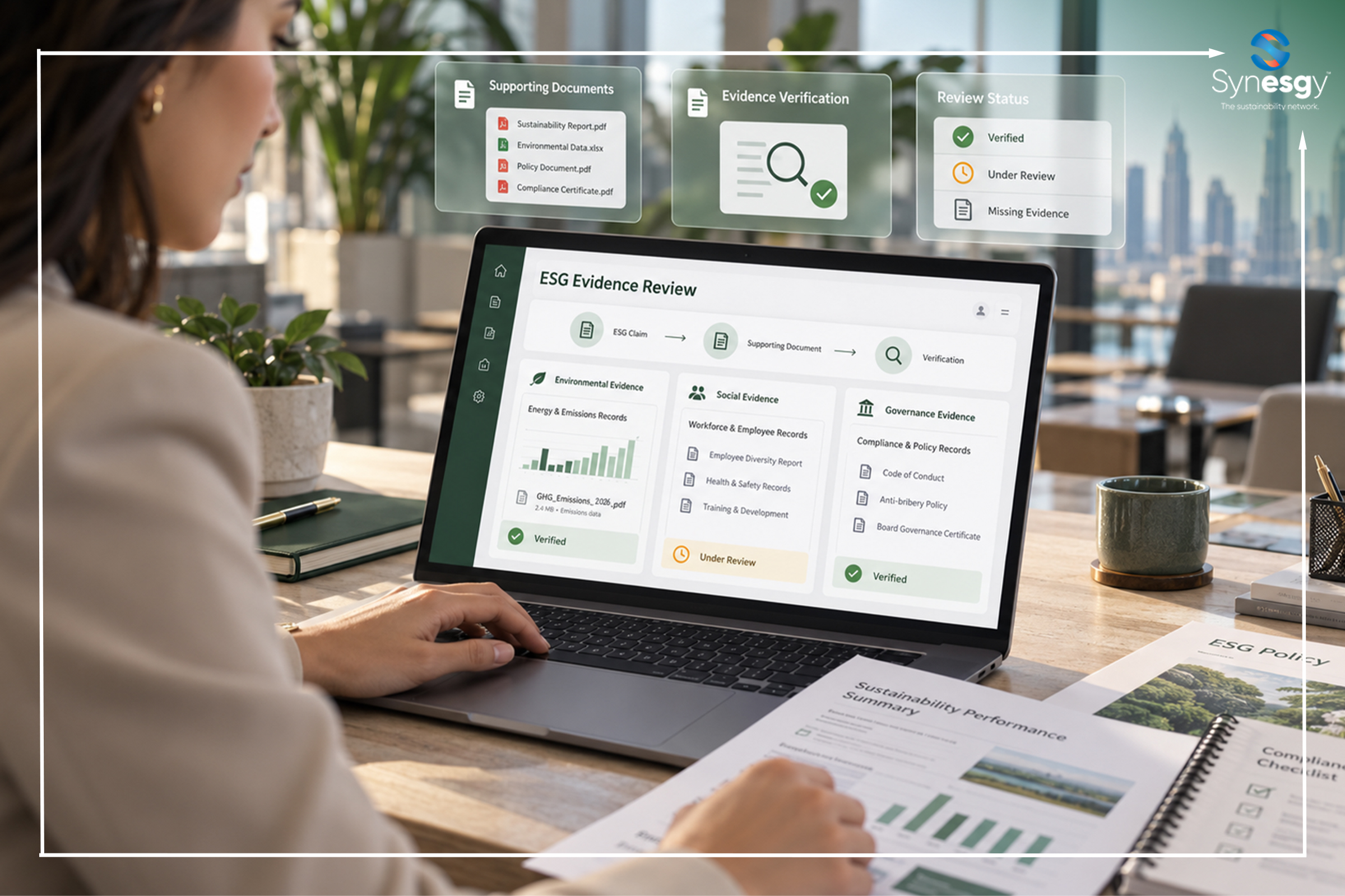
Corporate sustainability ratings provide a structured view of how a company performs across environmental, social, and governance factors. But a meaningful ESG rating cannot be built from isolated metrics alone.
Within the CRIF Synesgy Ratings methodology, an ESG assessment combines company-specific information, documentary evidence, quantitative and qualitative data, sector benchmarking, and expert judgement. The purpose is to evaluate a company’s sustainability profile in the context of the ESG matters that are relevant to its activities and sector.
This approach is important because two companies may report similar data while operating in very different sectors, with different sustainability priorities, management practices, and levels of supporting evidence. An evidence-based ESG assessment therefore needs to consider not only what information is reported, but also how that information is supported, how it compares with relevant sector practices, and how it should be interpreted within the company’s specific context.
What Makes a Corporate Sustainability Rating Reliable?
Within the ESG Rating Core methodology, the assessment is based on several principles, including:
-
impact materiality
-
sector-specific materiality
-
evidence-based assessment
-
expert analytical judgement
-
alignment with a VSME-based framework mapped, where applicable, to ESRS topics
The methodology combines company-specific information, sector benchmarks, and analyst judgement to evaluate the company’s degree of advancement across relevant sustainability matters.
This means an ESG rating is not determined by a single metric or a single sustainability disclosure.
The assessment considers environmental, social, and governance factors across defined areas of analysis. Environmental factors may include climate change, pollution, water, biodiversity, resource use, and circular economy. Social factors include the company’s own workforce and workers in the value chain. Governance factors include governance structures, internal policies, business conduct, compliance practices, and certifications.
The resulting ESG rating therefore reflects an assessment of multiple sustainability areas rather than a single environmental or operational indicator.
Why Is Evidence Important in ESG Assessment?
Evidence gives an ESG assessment a documented basis.
The ESG Rating Core methodology states that the reliability of the assessment depends on the quality, completeness, consistency, and relevance of the evidence available to the analyst. It also specifies that analysts should avoid assigning a score that is not adequately supported by evidence.
This is important because a company may state that it has sustainability policies, targets, management systems, or improvement initiatives. An evidence-based ESG assessment considers the information available to support those statements.
The methodology also distinguishes between missing information and verified poor performance. A lack of information should not automatically be interpreted as poor ESG performance. Instead, it should be assessed according to the relevant scoring criteria and the evidence available.
This creates an important distinction between what the company claims, what the available evidence demonstrates, and what cannot be determined from the information provided.
Supporting documentation therefore plays an important role in making the assessment traceable.
What Types of Evidence Are Used in an ESG Rating?
The ESG Rating Core methodology draws on several categories of information.
These can include:
-
company disclosures
-
sustainability reports and other ESG information
-
Synesgy questionnaire responses
-
documentary evidence
-
public company information
-
quantitative indicators
-
policies
-
action plans
-
initiatives
-
targets
-
certifications
-
qualitative supporting information
-
public ESG raw data elaborated by CRIF Group
The sample Rating Core report also lists examples of information sources that may be reviewed, including financial statements, codes of ethics, privacy policies, whistleblowing policies, internal regulations, the Synesgy questionnaire and attachments, and information from CRIF Group information assets.
The type of evidence used can vary depending on the ESG issue being assessed.
For example, an environmental assessment may consider quantitative indicators together with environmental policies, targets, certifications, and management systems.
A social assessment may consider workforce information, employment practices, health and safety policies, training, diversity, and supporting documentation.
A governance assessment may examine internal controls, codes of conduct, compliance arrangements, whistleblowing procedures, certifications, and governance responsibilities.
The objective is not simply to collect as much information as possible. The methodology requires the evidence to be relevant to the sustainability matter being assessed.
Why Does Sector Benchmarking Matter in Sustainability Ratings?
The significance of an ESG issue can vary considerably across sectors.
For this reason, the ESG Rating Core methodology applies sector-specific materiality and uses sector benchmarking as part of the assessment process.
The analyst reviews the sustainability characteristics, practices, and performance levels observed within the relevant sector and establishes a benchmark against which the company can be assessed.
This helps place company-specific information into context.
For example, the same sustainability indicator may not have the same analytical relevance for companies operating in different industries. The methodology explicitly states that the same evidence may have different analytical relevance depending on the company’s size, activities, and sector characteristics.
Sector benchmarking therefore helps move the assessment beyond simply checking whether a company has a particular policy or metric. It provides context by showing how advanced the company is compared with the sustainability practices and performance levels typically observed within its relevant sector.
Where a statistical sector benchmark is unavailable, the methodology allows analysts to use documented qualitative sector or market practices, provided the rationale is recorded.
This prevents the assessment from treating every business as though it operates under identical sustainability conditions.
How Does Expert Judgement Improve an ESG Rating?
In the CRIF Synesgy Ratings methodology, expert judgement is used to interpret evidence within the context of the company and its sector.
The analyst reviews:
-
relevant ESG matters
-
sector evidence
-
company-specific information
-
quantitative indicators
-
qualitative evidence
-
policies and initiatives
-
targets
-
certifications
-
supporting documentation
The company’s sustainability profile is then compared with the relevant sector benchmark before an Area Score is assigned.
The Area Score reflects the analyst’s assessment of the company’s degree of advancement in relation to the ESG matter being assessed.
This can include consideration of:
-
observed performance
-
management practices
-
implementation
-
quality of supporting evidence
-
position relative to the sector reference
Expert judgement therefore does not replace data.
Instead, it is used to interpret the available quantitative and qualitative information within the appropriate context.
The methodology also requires analysts applying the framework to have appropriate ESG and sector knowledge.
This is one of the main differences between an analyst-led ESG assessment and a purely automated assessment.
Why Are Data Alone Not Enough for a Comprehensive ESG Rating?
Data provides an essential foundation for ESG assessment, but individual indicators do not always explain how sustainability issues are being managed.
A quantitative indicator may show a level of emissions, water use, workforce composition, or another measurable factor.
However, understanding a company’s sustainability profile may also require consideration of:
-
management systems
-
policies
-
implementation
-
targets
-
initiatives
-
controls
-
supporting documentation
-
sector context
The ESG Rating Core methodology therefore uses both quantitative indicators and qualitative information.
This allows the assessment to examine both measurable outcomes and the structures or practices behind them.
For example, the existence of a policy alone may not provide a complete picture. The assessment may also need to consider the level of implementation, available evidence, and the company’s position relative to sector practices.
This is why the methodology uses integrated assessment rather than relying on a single dataset.
How Do Evidence, Benchmarks and Expert Judgement Work Together?
Evidence, sector benchmarking, and expert judgement play distinct but connected roles in ESG rating methodology.
Evidence provides the factual basis. Company disclosures, ESG indicators, policies, certifications, and supporting documents establish what can be verified.
Sector benchmarking provides context. A company’s sustainability performance is assessed against relevant sector characteristics and practices.
Expert judgement interprets the findings. Analysts evaluate the evidence, sector conditions, and company-specific factors to assign Area Scores.
These scores are aggregated into ESG topic scores and Environmental, Social, and Governance pillar assessments. Sector-specific weights are then applied to determine the overall ESG rating.
Each score must be traceable to supporting evidence and documented analytical reasoning, ensuring a structured and transparent assessment.
For businesses, this approach provides a clearer understanding of their sustainability performance beyond isolated ESG indicators.
Turn ESG Evidence into Actionable Sustainability Insights
Understand your company’s ESG performance through evidence-based assessments, sector-specific benchmarking, and expert analysis with Synesgy.
FAQs
Q: What evidence is used in an ESG rating?
A: Depending on the assessment, evidence can include company disclosures, sustainability reports, Synesgy questionnaire responses, documentary evidence, quantitative indicators, policies, action plans, initiatives, targets, certifications, public information, and other relevant ESG data. The ESG Rating Core methodology combines these information sources with sector benchmarking and analyst judgement.
Q: Why is sector benchmarking important in ESG assessment?
A: Sector benchmarking provides context for evaluating a company’s sustainability performance and management practices. The ESG Rating Core methodology compares the rated entity with characteristics, practices, and performance levels observed within the relevant sector. The same evidence can have different analytical significance depending on the company’s size, activities, and sector.
Q: What role does expert judgement play in ESG ratings?
A: Expert judgement is used to interpret quantitative and qualitative evidence in the context of the company and its sector. Analysts review company-specific information, sector evidence, management practices, implementation, supporting documentation, and relevant sustainability factors before assigning scores to the applicable areas of analysis.
Q: What is the difference between an automated ESG score and an analyst-led ESG rating?
A: The uploaded CRIF Synesgy Ratings materials describe different levels of ESG assessment. ESG Rating Smart is an automated assessment that combines questionnaire responses with statistical, proprietary, and publicly available information. ESG Rating Core is analyst-led and incorporates documentary evidence, sector benchmarking, company-specific information, and expert judgement. csr_esg_rating_smart_methodology
Q: Why are both quantitative and qualitative data needed in ESG assessment?
A: Quantitative indicators provide measurable information about sustainability performance, while qualitative information helps assess policies, management practices, implementation, targets, certifications, and other contextual factors. The ESG Rating Core methodology integrates both types of information when evaluating the company’s degree of advancement in relevant ESG areas.